OPENING
Introduction
As human beings, we have at least five well-known senses: sight, touch, smell, taste and hearing. It is through them that we gather information from the world around us.
But our perception is not limited to those five senses. We also have internal mechanisms that help us sense the position of the body in space, such as proprioception, and the internal state of the organism, such as interoception. In other words, we are not just receiving information from the outside world; we are also constantly receiving information from our own body.
Our experience of reality is born from that meeting: what the senses pick up, what the body feels and what the mind interprets.
That is why two people can stand in front of the same situation and live completely different experiences. They can look at the same facial expression, hear the same words or share the same environment, and still read them in different ways.
One may interpret silence as rejection. Another may see it simply as tiredness. One may feel a criticism as a threat. Another may receive it as useful information. The stimulus may be the same, but each person's body, history, memories, emotional state and beliefs shape the way that stimulus is perceived.
This means we do not react only to reality. We react to the way reality appears inside us.
There is a very clear example of this in a video I posted recently (https://www.instagram.com/p/DW_P295iB8n/) of identical triplets (same DNA) who, faced with a difficulty, reacted in completely different ways. One started crying, another stood still and watched, and the third decided to do something about it. That last one found a way past the obstacle and got hold of the three bottles, then handed them out to his brothers. The one who had started crying kept the same attitude even after his brother gave him the bottle. So we are talking about three babies with the same DNA and the same upbringing, showing very early differences in temperament.
You cannot conclude from a single video that a baby "is like that", but it does raise an important idea: not everything starts with upbringing or with experiences we can point to. Some tendencies seem to show up very early, before there is language, beliefs or a formed personal narrative.
We also know that our story starts being written in our mother's womb. That culture, bonds and the experiences that come afterwards keep shaping who we are.
But are we only a product of what happened to us and of the genetic material we were born with?
Or do we have a say in the experiences we live and in the way we live them?
Would it be fair to say there is little room for free will?
To try to answer that, it helps to go back in time. We descend from many forms of life and, if we go back millions upon millions of years, we arrive at single-celled organisms. Those organisms had no senses like ours, no brain, no language, no inner narrative about the world. But they were not completely passive. Even a simple cell could respond to its environment: it detected chemical signals, light, temperature, nutrients or threat, and adjusted its behaviour accordingly.
In other words, before there was a mind saying "I choose", there was already life responding to its surroundings.
At what point does an automatic response gain enough room to become a choice?
That is: when do we stop being just an organism reacting to its environment, and start being a being capable of observing its own reaction, interrupting it and acting another way?
This book exists to sit with a question that is simple to ask and hard to answer: what is, after all, the potential of a human being?
Are we just animals conditioned by impulses, addictions, fears and needs?
Are we passive agents of our own life, victims of genetics, childhood, culture, environment and the things that happened to us? Or is there some margin of freedom in us?
And if that freedom exists, how big is it?
Maybe we are not as free as we like to imagine. But maybe we are not just what happened to us either. It is in that space, between impulse and choice, between conditioning and awareness, between what we inherited and what we can work on, that this book begins.
The aim of this book
This book was not born from an attempt to reach a closed truth. It was born from a simpler attempt, and perhaps a more honest one, to get closer to it.
I want to bring together science, the teachings of yoga and my own experience to investigate how far the potential of a human being can go.
I am not talking only about physical, professional or material potential. I am talking about the possibility of living with more clarity, more presence and less compulsion.
Science shows us that we are deeply conditioned. By genetics, by environment, by culture, by the nervous system, by habits, by sleep, by emotions and by the experiences we have had.
Yoga points to another possibility: that, despite all that conditioning, there may be a dimension in us capable of observing the body, observing the mind and creating distance from their impulses.
My personal experience sits somewhere between these two lenses.
In some experiences with psychedelics, I had glimpses of inner states that showed me that my habitual way of living was not the only one possible.
I do not see that as a final truth, nor as a spiritual shortcut, but as a window. A window into a human possibility that then needs to be integrated, practised and, ideally, cultivated without depending on any substance.
Since then, I have managed to reproduce part of that state without taking anything. Not permanently. Not perfectly. But enough to understand that maybe there is a path.
And it is that path I want to investigate.
How to read this book
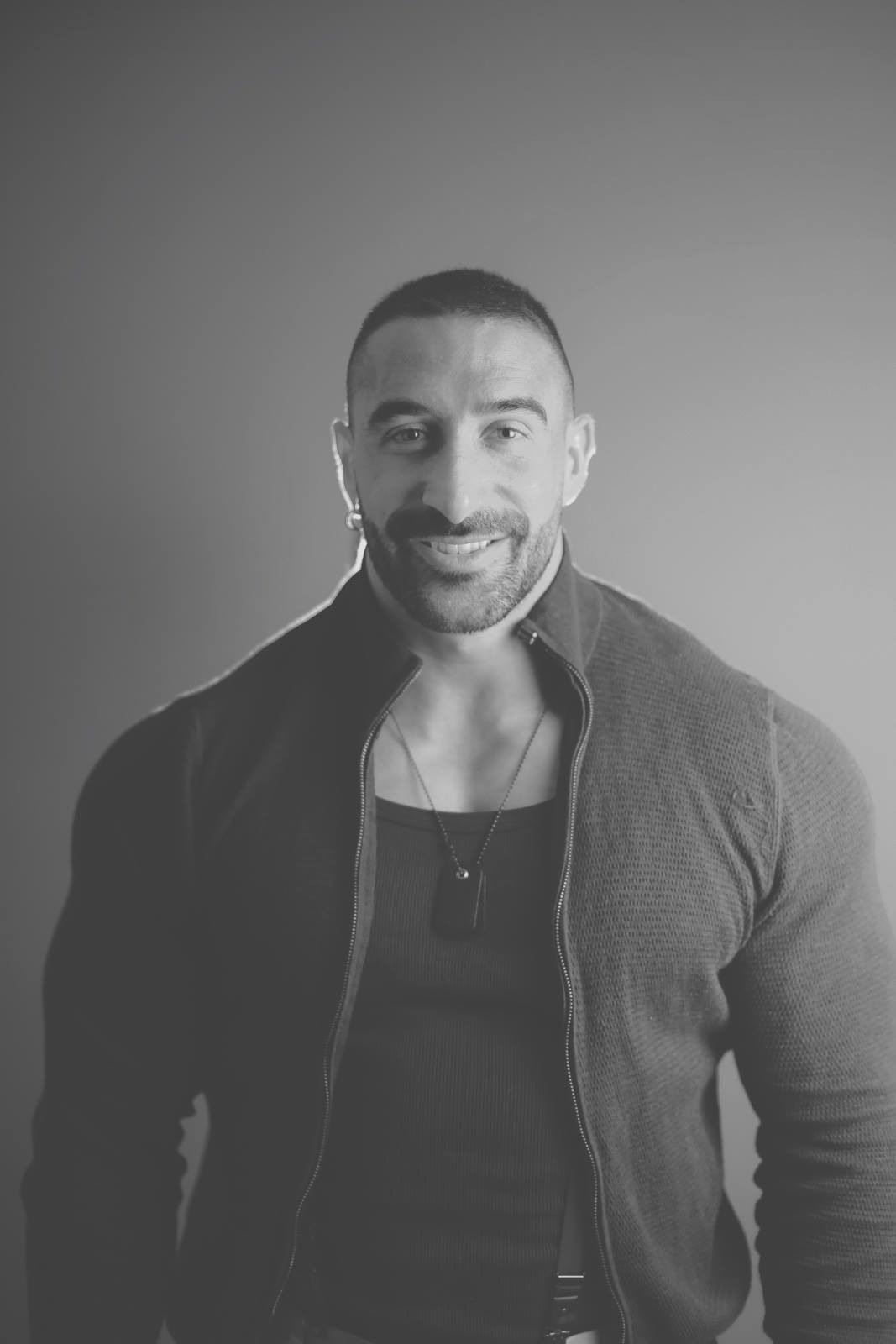
The author.
I was born in Guarda, but I belong to the world.
I am 36 years old and I have a great need to express myself through writing and, quite often, out loud on my social media.
I like humour, learning, driving at night with no destination, and a good glass of port with good music playing.
I like martial arts, reading, being alone and staying still.
I help people get in shape and I hope that, along the way, I can also help them understand that a healthy body and a healthy mind are the minimum requirement for a life well lived.
I carry a constant worry that forces me to watch the things I say and write. I do not want to be a parrot that reads, memorises and repeats things it does not believe.
But I have done it. And, every now and then, I still catch myself doing it.
When that happens, and when awareness allows me to spot it, I try to go back and correct it.
Do not take anything you read here as absolute truth, and feel free to discard whatever makes no sense to you. More than giving you certainties, which I do not have, I want to lead you to question, to experiment, to develop critical thinking and your own logic.
What is left is to explain the method, which is simple. Throughout the book, I try to look at each idea through three different lenses. The lens of science. The lens of yoga. And my own lens, the lens of lived experience. This last one is the most dangerous of the three, precisely because it is mine, full of biases and of stories I keep telling myself. So I make a constant effort to keep it as clean as possible, to see things with less dirt in the way. Further ahead you will understand this image better, and the joke hidden in it.
Since I will use these two words a lot, science and yoga, it is worth saying now what I mean by them. When I talk about science, I mean what we can observe, measure, test and, above all, repeat. Knowledge that does not depend on my opinion or yours: if the same experiment gives the same result, whoever runs it, then there is something solid there. Science does not have all the answers, and it changes its mind when the facts change. But it is the best tool we have for not fooling ourselves.
And when I talk about yoga, forget the Instagram poses for a moment, although they are part of the story too. The word points to something much older and much wider: a body of practices and wisdom thousands of years old, born in India, that leans over a question very similar to mine, the question of how a human being breaks loose from its own conditioning. The body, the breath and the mind are the tools. Inner silence is the destination. Where science looks from the outside, with a microscope, yoga looks from the inside, through direct experience. Two different ways of investigating the same thing: us.
Throughout the book you will also find old texts, written by me several years ago. I leave them in for two reasons. Some because today I think differently, and they serve to show that change. Others because, curiously, I already thought this way back then, and they serve to reinforce that these ideas were not born yesterday. They are always signposted, and next to each one I leave the year it was written.
PART ITHE CONDITIONED ANIMAL
Where you come from. Why you are not as free as you think.
The count that never ends
Picture a dirt road. Up ahead, a man walks slowly, barefoot, in no hurry at all. Behind him, running, comes another with a sword in his hand and a necklace around his neck. The necklace is not made of beads or gold. It is made of human fingers.
They called him Angulimala, "the finger necklace". He had collected nine hundred and ninety-nine and was one short of a thousand, a count someone had planted in his head and that he was carrying through to the end, whatever it cost. That morning, the thousandth finger could be that calm walker's.
Except something strange happens. Angulimala runs with everything he has and cannot reach him. The other man moves at walking pace, and still stays ahead, out of the sword's reach.
Who is the walking man? They call him the Awakened One, the one who woke up. That is what Buddha means, someone who opened his eyes. He walks without fear of a murderer because there is nothing in him that can be taken. He is not chasing tomorrow, he does not want to be anything more than he already is. Angulimala runs after everything. The other, ahead of him, runs after nothing, and maybe that is exactly why no one catches him. You cannot catch, by running, someone who is no longer fleeing from anywhere.
Exhausted, furious, Angulimala shouts at him to stop. And the man, without turning around, answers: "I have already stopped. You stop too."
Hold on to this image. We will come back to it.
Because the question left hanging is simple: stop what?
Angulimala thought he was one finger short. Always one more. And if you look closely, what drove him is not that different from what drives you. Notice. You conquer the city and you want the country. You have the country and the world looks small. If they gave you the whole world, you would look at the sky and ask about the next galaxy. You get the car and you want the next one. You reach the number in your bank account that you swore would finally let you rest, and the next day there is already another number.
The temptation is to call this greed and leave it there. I think it runs deeper. Underneath it all there is an enormous thirst, and the thirst itself is the most human thing there is: we want to expand. We want to be more, to be bigger, to be without limits. Angulimala had that thirst in its raw state, wielded brutally. You have the same one, just better dressed.
What goes wrong is where we point it. When an infinite thirst throws itself at finite things, a finger, a car, one more zero in the balance, a follower count, the brain throws a party for an instant, dopamine spikes, and then goes quiet. Whatever you get used to stops feeding you, and in the chapter on adaptation you will understand why this always happens. The count goes up, the feeling does not. And the thirst stays hungry. That is how desire, which was only desire, became compulsion. Angulimala is the extreme version of it. One more finger, one more finger, and never the necklace that is enough.
Now, what if the thirst is right and only the direction is wrong?
The word yoga means union. And the yogis, who spent centuries looking inwards instead of outwards, arrived at a conclusion that is hard to swallow: a human being is not chasing a car or a country. He is chasing becoming limitless. He just confuses becoming limitless with having more things. And however high you stack them, you remain on the inside of your own skin, with the same border around you.
Yoga's proposal is to take the same desire and turn it inside out. You do not expand by accumulating the world out there. You expand by letting fall the wall that separates the "I" from everything else. It is an expansion that quenches, because it is what the thirst wanted all along, not an imitation that wears out in two days. I am not asking you to believe this. Keep the question and test it for yourself, because that is what this book is about.
Now go back to the road. That walker had already arrived at the place Angulimala was trying to reach through fingers. He was already limitless, and that is why he could walk slowly in front of a sword. "I have already stopped" meant this: I no longer need to chase anything in order to be whole. And then something happened that no one would expect. Angulimala dropped the sword. In that instant, stopping gave him what a thousand fingers never had.
And here we both stand, at the start of the book, with the same question around our neck instead of a necklace: the thing you chase without rest, does it actually give you what it promised? Or does it just keep you counting?
Chapter 1: The snowball
Remember the triplets from the beginning? Same DNA, same home, and three different ways of reacting to the same problem. That is the starting point. The first handful of snow each of us rolls down the slope with.
But it is only the beginning. From there, life takes charge of adding layers. The family we land in, the place where we grow up, the people who mark us, what we are told we are and what we decide to believe. All of it keeps sticking, turn after turn, until it forms the person who answers to our name today.
My snowball started in a cold city, the highest in Portugal. And, like almost everyone, I took years to understand the weight of what I had been accumulating along the way.
I was born into a middle-class family, if that division still means anything today, and I am the youngest of four boys.
A family that valued work, saving, truthfulness and other values I still try to keep today.
I grew up very close to my mother. It was with her that I made the daily trips to nursery school, which was next to the school where she worked.
Later I would attend that same school.
The pressure of being an example fell on me every day. But it was a welcome pressure.
I remember many mornings, sitting at the breakfast table, telling her:
"Mum, I'm going to be a very intelligent, very successful person. I'm going to make you proud."
She would smile.
I was always very curious and had an enormous desire to learn. On those walks to school, my conversations with my mother were almost an interrogation.
I felt like a real journalist.
I held a pen as if it were a microphone, and my subject of investigation was simple:
Life.
I always had good marks. And if for some reason I misbehaved, there was a ruler on my mother's desk that served to remind me of my place.
The downside of having your mother as a teacher is that you "get it" both at school and at home.
"That's how you raise a man," my father would say, trying to soften the sting.
And since I was not one to dwell on things, five minutes later all was well again.
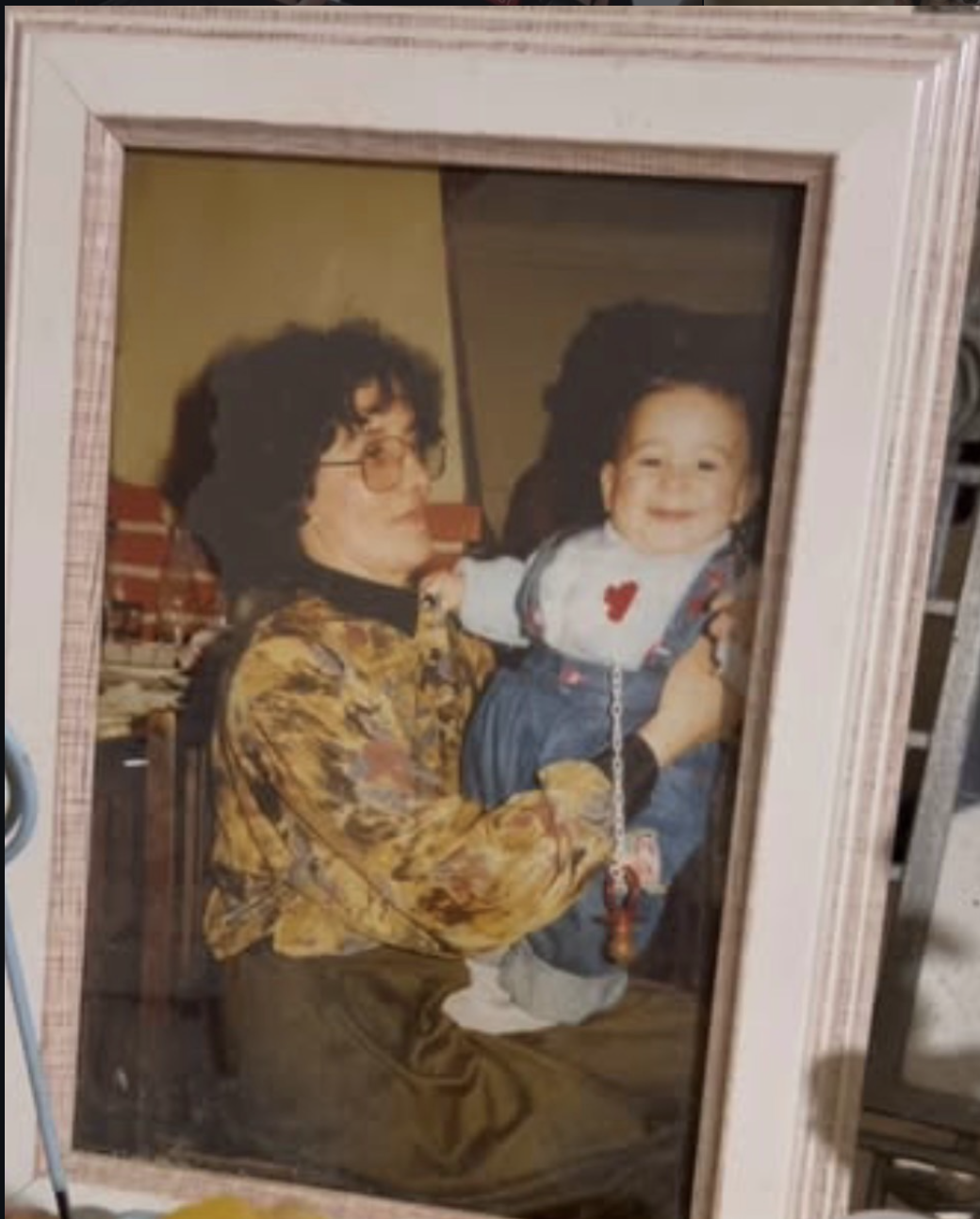
With my mother, as a boy.
From the archive · Snowball (2019)
Imagine a snowball. As it rolls down a ravine, it keeps getting bigger. It gathers more snow, growing heavier. It picks up snow along the way, making it part of itself.
What do we have in common with that snowball?
A lot.
Throughout our life we keep the snow that people deposit in us, we accumulate images, information, realities, experiences, consciously and unconsciously. So our
"self" of today is an accumulation of all of that. Nobody wakes up depressed, and nobody wakes up wildly successful overnight. There was an accumulation of thoughts and of internal and external information being processed constantly that brought us to our current state.
Whether the present picture is good or bad, it is easy to see the importance of watching the kind of information we let in, the kind of experiences we want to have, the people we want to see and keep at our side. The habits we want to build. Everything you do today will show up later, all the accumulated snow will mirror your inner and outer path.
Watch your perceptions, the people you spend time with, the moments you choose to live
We are born with a genetic base that tilts temperament in one direction. What the triplets show so early, the tendency to cry, to observe or to act, has a part that comes already written.
But written does not mean fixed. There is a field, epigenetics, that studies how the environment switches genes on and off without altering them. The way you live, what you expose yourself to, stress, sleep, food, all of it influences which of your genetic instructions actually get used. It is often said that genetics loads the gun and the environment pulls the trigger.
On top of that comes everything else. Culture, language, family, experiences, the episodes that marked us and the conclusions, often wrong, that we drew from them. Each of those layers starts working as a filter. We stop seeing reality and start seeing our version of it, coloured by everything we have already accumulated.
A few thousand years before anyone spoke of genes, yoga already had a word for this snowball: karma.
Forget the punishment-and-reward version, the "you misbehaved, you will pay". That is not it. In yoga's view, karma is memory. It is everything that got recorded in you and now runs on autopilot. And it speaks of several kinds of that memory: the physical and evolutionary kind, which you carry in your body; the genetic kind, inherited from those who came before you; the emotional; the mental; and even an energetic memory. Layers upon layers of accumulated information, shaping the way you react without you even thinking.
It is the same snowball, said in other words: what you drag along with you and what, if you are not careful, lives your life for you.
This is why two people live through the same thing and feel different things. They are not reacting to what happened, but to the way it lands inside, after passing through all those layers.
Seeing the snowball is the first step. Because only after you see it can you start choosing what snow you want to keep gathering.
Closing question: what snow have you been gathering throughout your life, that you still carry today without even noticing?
Chapter 2: The pike
There is an old experiment, attributed to the German zoologist Karl Möbius, somewhere around 1873, that tells us something about ourselves very well.
They took a pike, a freshwater predator fish, and put it in an aquarium. In the middle, a transparent pane of glass dividing the space. On the other side, small fish, food in plain sight. The pike did what any predator would do: it lunged. It slammed full force into the glass. And it lunged again, over and over, always against the same invisible wall, until it was left belly-up recovering from the impact. After a while, it gave up. It learned that trying was not worth it.
That was when they removed the glass.
The small fish started swimming right in front of its mouth, literally. And the pike, nothing. Still, starving, in the middle of abundance, convinced the barrier was still there. There are reports of pike that let themselves starve to death with dinner bumping into their snout.
This behaviour was later called the pike effect. And the question that matters is simple: how far from it do you think you are?
Because your brain does the same. It files away certain experiences as if they were permanent truths and then goes home to rest, convinced it already knows everything there is to know about the matter. The difference is that we, more sophisticated than the poor pike, build far more elaborate panes of glass. We give them good arguments. We wrap them in an entire, well-assembled narrative that justifies in detail why we no longer do anything about the thing that bothers us.
And it is not only with fish. Psychology went to the same behaviour, in one of the saddest experiments ever run. In the sixties, two researchers, Martin Seligman and Steven Maier, exposed dogs to small shocks from which there was no way to escape. Whatever they did, the shock continued. After a while, the dogs stopped trying. So far, nothing new. What came next is what matters: when they were placed in a box where jumping over a low barrier was enough to escape, most did not even try. They stayed there, lying down, enduring. They had learned something that was no longer true, that nothing they did changed the outcome, and they kept living as if that truth still held them. It was called learned helplessness. And the most revealing part came when the idea was repeated with people: they found that we do exactly the same. It is the pike, on four legs, and, very probably, it is also you, in whatever area of your life where you have already given up trying without even noticing that the glass was lifted.
The yogis, who had no aquariums and no dogs to observe, got there another way: by looking inwards. They called these grooves samskaras, and the image they used is this. Every time you repeat a behaviour, a thought, a reaction, it is as if you rolled a wheel over the same spot in soft earth. At first it is only a mark. With repetition, it becomes a track. And at some point the track is so deep that the wheel falls into it by itself, without you deciding anything. Your addictions, your fears, your certainties, many of them are this: grooves worn down from being travelled so often. And a groove is not forever, something this book will repeat in a thousand ways. You stop feeding it, and slowly you open a new path beside it, until the wheel starts preferring that one.
Raising your level of awareness is, in good part, this: noticing when you are banging your head against a pane of glass that no longer exists. Or, worse still, when there is no aquarium at all and you are hitting the wall out of pure habit.
The pike had no way of knowing. You do.
I am a specialist in building panes like these. Let me give you a comical example.
For years I had the habit of defending opinions that were not even mine. Once, in an argument about politics, a subject I honestly do not care about or understand much, I found myself defending a position tooth and nail. Reciting whole sentences I had heard somewhere, delivered with a conviction that had no foundation whatsoever. It is what I usually call parrot syndrome: repeating what you hear as if it were your own wisdom.
And the worst part is that, when we cling to one of those borrowed ideas, we build a character around it and start defending it as if our life were at stake. It is a pane of glass we raise with our own hands and bang our head against, convinced we are protecting something important. That habit has already cost me dearly, including a friendship, but I will tell you about that further ahead.
From the archive · Your Voice (2014)
You will look at this text, you will remember all the pain you have ever felt, you will remember every tear, every punch, every sword through the heart, every abandonment and all the hell that has ever passed through you!
You will also remember that you are here today, you are well and you will get better still. You will recall that every moment served to build the person you are today, that every victory of yours was the fruit of pain, work and perseverance.
You know that tickling feeling in the chest and at the back of the neck?
That very one, that feeling was there in every one of your victories. Before, during the process and after! Use it, it is your strength.
Do you still doubt yourself? Do you still doubt what you are capable of doing when you set your mind to something and give yourself to it body and soul?
Come on, relax, ask, feel, act and conquer once more!!
From me to you… your voice.
A question stays with you: what glass are you still banging your head against? What barrier are you respecting that, just maybe, no longer exists? And what story do you tell yourself to justify not trying?
Chapter 3: The masks
The masks we wear.
The knife and the hand that holds it
Sadhguru has an image I like very much: the intellect is like a knife.
A knife's job is to cut. To separate, divide, dissect. In that sense, the sharper the better. A dull intellect is confused, slow, imprecise. A sharp intellect distinguishes, organises, notices differences, decides. So far, so good.
The problem is that a knife, however good, is not good for everything. Trying to solve your whole life with the intellect alone is like trying to sew clothes with a knife. Excellent at cutting, terrible at joining. And there is a good part of life, the part about integrating, feeling, living things as a whole, that is not cut. It is sewn.
But the part that really interests me is this: who is holding the knife?
In his image, the intellect is the blade. The hand holding it is identity. And that is where everything is decided. A knife is only as good as the hand that grips it.
If my identity is small and rigid, "I am this body", "I am this opinion", "I am this status", "I am this wound", "I am this character", then the knife starts cutting everything from that place. The same intelligence that could bring clarity starts working part-time for the ego. It stops analysing reality and starts making excuses: justifying fears, resentments, feelings of superiority, of inferiority, of victimhood, and all those little internal soap operas the mind writes with a talent that could have gone to better use.
And Sadhguru closes with an idea that stayed with me: when the hand trembles, the knife ends up cutting the one holding it. Most suffering does not come from outside. It comes from using this razor-sharp tool against ourselves.
So the solution is not to blunt the knife. It is the opposite. Sharpen the intellect as much as you can, but see to widening your identity. Because a very sharp intellect gripped by a small, defensive, nervous identity is just that: a dangerous knife in the hand of someone in distress. It can chop the vegetables, yes. But it can also wreck the whole kitchen and then blame the onion.
We have talked about the knife and the hand that holds it. The hand is identity. And identity, in practice, dresses up as a character.
We all have characters. Not in the sense of theatre or pretending, but in the sense of identity: the way you speak, what you value, the kind of life you are willing to build, the kind of discomfort you accept. There are characters we choose carefully and there are characters that simply appear in front of us and we put on without noticing.
There is nothing wrong with having a character. What costs dearly is forgetting that it is a character. It is gripping it so tightly that you no longer know where you end and the costume begins. That is exactly what happened to me. Twice, with two different costumes.
The bodybuilder's mask
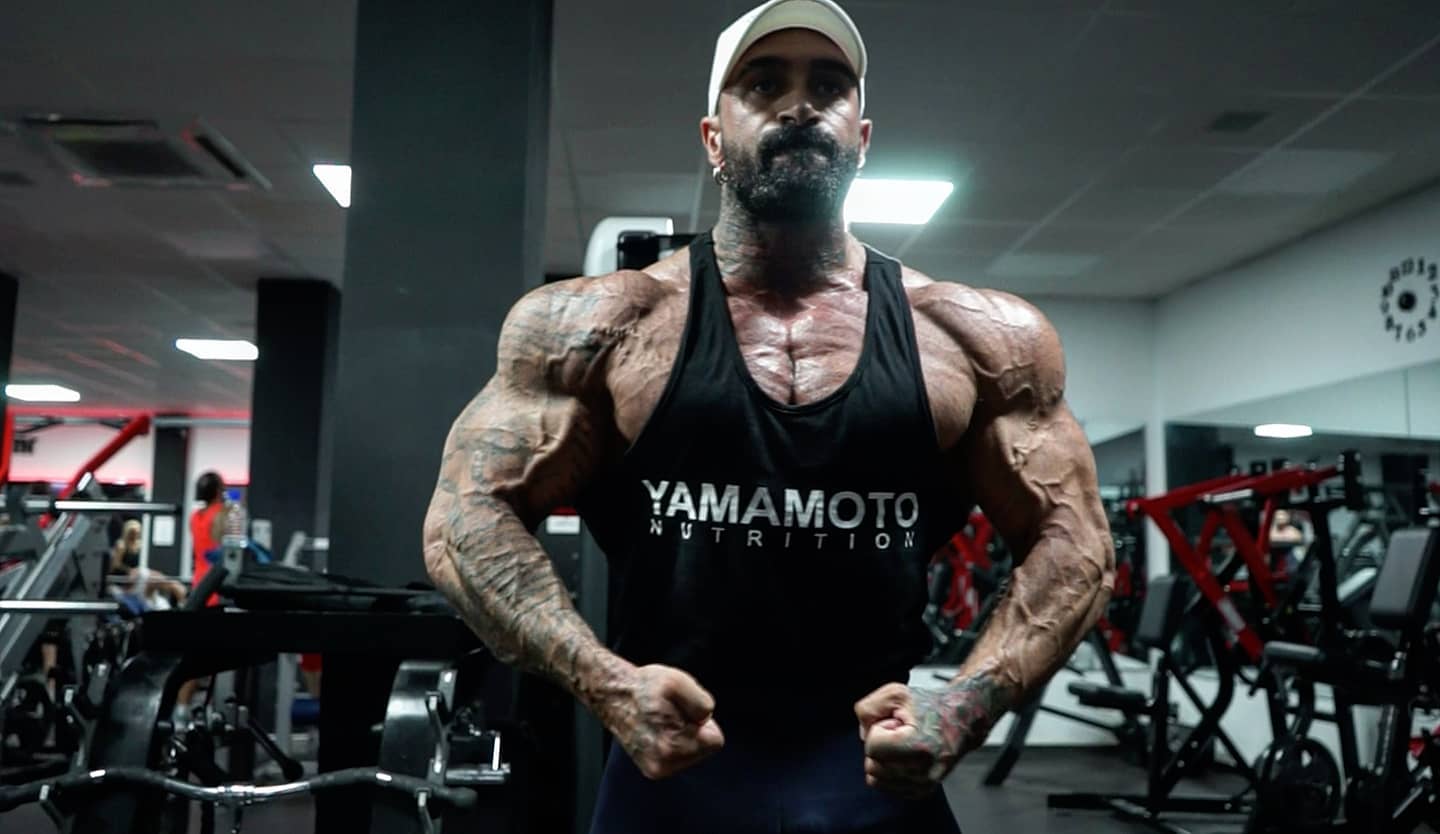
The bodybuilder.
My obsession with my body, with getting muscular and lean (big and shredded), led me to study different fields. Even before entering university, my head was busy with questions about nutrition, training and psychology.
University brought me more knowledge, but not enough for the results I wanted. Seeking out people who had already been through the process I wanted to go through was valuable. This obsession led me into the world of bodybuilding, to living like an athlete and to helping other people with the same interest.
I believe I took it to a limit that went far beyond my expectations. 120 kg at 10 to 12 per cent body fat was a mark my "younger self" would have been proud of. I had built the body I wanted.
Except that, at some point, the body and the character merged. The steroids were part of the costume. They served to keep standing a Tiago I had taken years to build and no longer knew how to take off.
The bodybuilder's voice, at the height of the character.
From the archive · Sculpted by Pain (2018)
I love this so much because in it I find all the answers to my needs, I fulfil myself in myself and realise myself, where I outdo myself and am rewarded for it.
It gives me certainties I need as a survival mechanism, it brings me variety, uncertainty about what will happen, what obstacles I will have to face, to make me, today, someone better than yesterday.
It also answers that need to feel in constant evolution, stopping is dying, stagnating means not living, and I want to live in fullness, I need to feel alive, special, a unique being.
I need progress as much as I need to breathe, for progress is the air I inhale and what gets me up every day. When my strength fails me, the progress mirrored not only in my physique but in my soul will give me the spirit I need, the last breath.
It gives me connection, a bond, with myself and with those who walk beside me hand in hand.
In this game of certainties, uncertainties and progress, I find love, I find connection, with my self, with my resourceful state, with the beings who hold me up on this painful and defining climb.
I am not selfish, or maybe I am. But I know my time will come to give, to contribute, to be present, to hold the hand that once held my chin and told me I would make it to the end.
With this I fulfil myself, with this I complete myself, bodybuilding is my pain, it is my passion and my life. I carry my success on my body 24 hours a day. My reflection is my project, and my soul my masterpiece.
Through iron, through blood, sweat and tears, I build myself, day after day, like a sculpture that will never be finished, I am like you… sculpted by pain!
The mirror, in Barcelona
I wrote that with all the conviction in the world. And it was that same conviction that, years later, I had to dismantle. I have spoken openly about steroids since 2015, when I became national bodybuilding champion in the under-85 kg category.
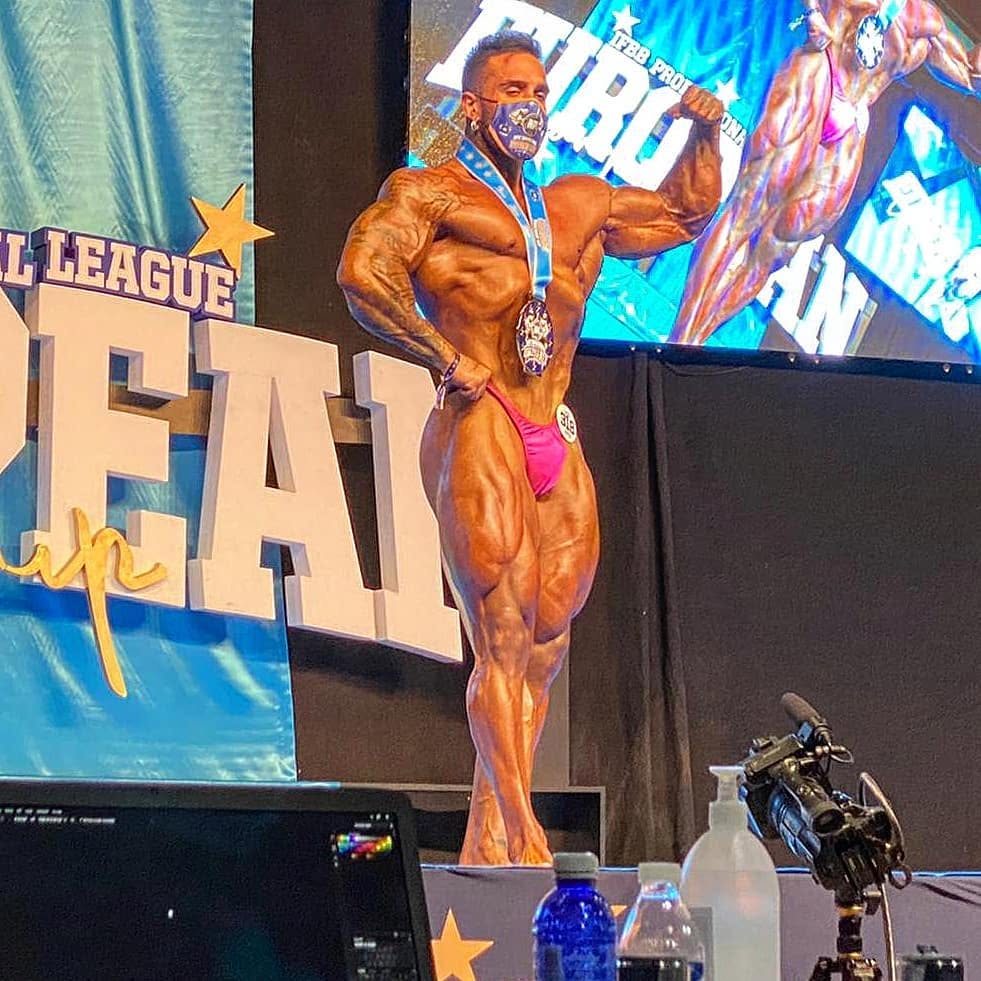
Competing.
Precisely because I spoke about the subject, the federation's higher bodies asked me to stop doing so, under threat of being expelled and stripped of the title. I accepted the punishment, in exchange for keeping the freedom to speak. At the time, it was a taboo subject. Today it is discussed without any shame. We swung from one extreme to the other, and that sentence carries no judgement about which is more correct.
I have always approached the subject for what it is. Without promoting it and without trying to convince anyone not to do it. I like to treat others the way I would like to be treated: as an adult who thinks with his own head, and who does it better when the facts are in front of him, stripped of ideology.
I keep that stance. I do not intend to tell anyone what they should or should not do. But one thing is not an opinion: steroids will have an impact on your physical and mental health. Only the magnitude varies from person to person. The dose, the compounds and the duration determine the severity of each side effect and the chance of treating it. It is Russian roulette. When we are young, we think those things only happen to other people. With time, and with some attention, we start questioning whether that is really the path.
In my case, it became clear that it was not.
I was training in a gym in Barcelona when I looked in the mirror and saw myself. Bald, 120 kg, veins everywhere, shoulders the size of a head. Struggling to breathe, to sit down, to walk. A constant feeling of drowning. And, on top of everything, an enormous weight in my head.
What is this for? What am I doing with my life, with my body, with my health?
I had no neck. There was no distinction between body and head. I disapproved of what I saw and made a decision.
This ends here.
That was the day I decided to stop taking steroids and stop living as a bodybuilder. Weeks later, I made another decision I had been postponing: to stop coaching competitors. The character that had taken so much time, energy and mental health to build was undone with a simple decision.
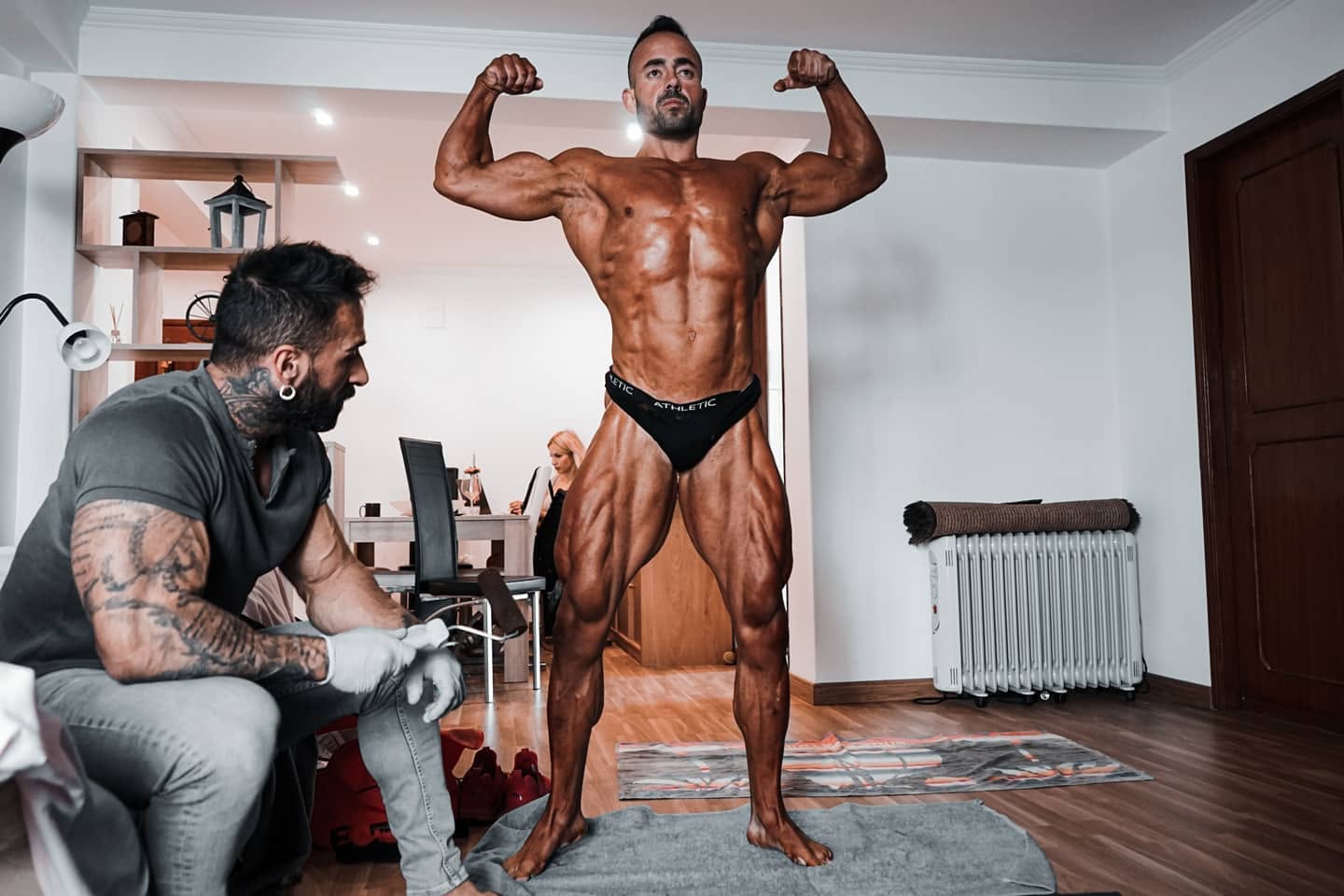
Coaching athletes.
Here I want to be honest, because the physical part shows in the mirror, but the mental part does not. Steroids messed with my head as much as with my body.
Irritability was always just under the skin. It took very little for me to explode. There was a background aggression I confused for years with "drive", and a crash, a heavy emptiness, whenever I stopped. It took me time to understand that part of that was not my temperament. It was chemistry.
Fortunately, most of the side effects were reversed, at least for now. But a large part of the hair I lost is not coming back, and it is very likely that I will depend on hormone replacement for the rest of my life.
There is one detail that shows exactly what kind of roulette this is. Excess testosterone thickens the blood. The body produces more red blood cells, the blood becomes more viscous, and that raises the risk of clots and stroke. This is measured, among other things, by a value called haematocrit. If my haematocrit were very high right now, I would be barred from doing testosterone replacement safely. Which would mean living without testosterone for the rest of my life.
Do you see how serious that is?
I lost a body that took me years to build. I lost an identity. I lost a mask. But I did not lose myself.
The businessman's mask

The businessman.
Another mask I wore with the same intensity was the businessman's.
Dressed up in waistcoat and shirt.
"Dressed for success" and brain configured with the phrase "just fucking do it".
There was no time for excuses, for playing the victim, or even for being empathetic.
Everything was seen as: "what can I get out of this" or "what can this person do for me".
Efficiency, profit and productivity.
But why on earth did I choose this narrative to define what a businessman is?
One of the mentors I had at the time, and one who marked me the most, was the embodiment of that narrative. The influence was very strong and it brought results.
Did it ever… Results and a fair amount of madness.
Material goals would serve as tangible milestones to measure how successful I was.
Paradoxically, the more successful I supposedly was, the emptier I felt.
And I recognised that emptiness. I felt it when I stopped. I felt it between achieving one goal and choosing another. Or perhaps, always.
And when I chose a goal, it was a kind of contract I signed: Once this is achieved, I will be at peace, be accepted, be loved. Until then, get to work, you cunt.
I never said this out loud. Maybe if I had, I would have realised how senseless the proposal was.
The unread small print of that contract: "Everything will stay the same inside." In fact, let me leave you one more belief:
Once your basic needs are met, a full belly and a place to sleep, you solve those problems and a thousand others show up.
Once those problems are solved, a thousand others appear.
One of my beliefs is that there are inner conditions, which cover the care of your body, the working of your mind and something more, which we will talk about later. And outer conditions, which concern everything else.
As a rule, success as we know it concerns the outer conditions. Material goods, comfort, convenience, opportunities, building something. And I know this is unthinkable for some, but I would place interpersonal relationships here too.
You can have all the success in the world and feel empty.
And I do not believe it is something that can be filled with a purpose, the way you usually read.
Good people around you, meaningful relationships and a well-kept environment will always have an impact on each of us, but if our inner state does not allow us to see it…
Just as you can have nothing (beyond the basic needs) and be a happy person, at peace.
For me, happiness and peace are the same thing. The happiness I am talking about here is not the same as the joy you feel when you buy a car you really want, I am not talking about excitement over something you are about to get.
It is not the same thing, but it is looking into the eyes of someone you love, in silence, it is looking at your pet with appreciation, it is an opening in the chest area, it is breathing and taking pleasure in it.
I am short of words and examples. So peace and happiness are the closest ones.
That does not mean having no problems, or not feeling all the emotions present in a human being, including the ones considered negative. I am only talking about a background curtain that lets you live life more lightly, where you see things for what they are, without mental drama.
I lived that first-hand. I had a purpose, I had material goods, success, recognition, good relationships, an abundant environment, status, the body I wanted, and yet there I was, empty.
Let me give you a concrete example, written at exactly the time it happened.
From the archive · A Goal Achieved, a Symbol of Success for Me (2018)
Four years ago, a specific car caught my eye. I walked into the dealership and sat in it. I took in the smell, felt the upholstery, the steering wheel, and burned that sensation, that moment, into my mind.
I confess I felt powerless and I can even say I felt pain at not being able to have the car. That same pain was what drove me, over the following four years, to learn about finance, about how to improve the way I worked, to evolve as a human being, as a professional. Helping others get what they wanted would help me get what I wanted. I was not expecting to find happiness in a car, but I am perfectly aware of what financial freedom can bring to a human being.
Experiences, joys, good moments. Money is energy, and it can be seen as bad or as good, depending on the observer. I have chosen, for as long as I can remember, to look at it as an infinite possibility of experiences and as a way of helping others.
Not through handouts, but through inspiration. I do not look at other people who are doing well in life with disdain, quite the opposite, I use them as inspiration. I do not waste time wishing people ill or envying them, or even talking about or speculating on anyone's life.
My time is dedicated to improving myself physically, mentally, spiritually and professionally, doing more than I am paid to do, giving thanks for the gifts I have and will receive, and acting with confidence.
I have failed so many times along my path and I will fail many more. Those failures, or flops in the eyes of the "Instagram spectators", are excellent opportunities for growth.
And the truth is that this fear most people feel, tied to other people's opinions, is enough to stop them from even starting or moving forward with anything.
But remember, my friends, those spectators of other people's lives are miserable souls looking for comfort in the venom they spit. My message is simple: focus on your own path, invest in yourself, invest for the long term, do more than you are paid to do, improve each of your abilities a little more, feed your brain and your body with good things, and never compare yourself with anyone!
You cannot imagine the headaches this "beast" gave me. With those pains, a lot of learning too. But, as I had already noticed in so many other situations in my life, it is when we let go of the obsession with having something that we finally get it. It is good to have goals, but not obsessions. An obsession drains us at the energy level, and I had the habit of turning everything I got into into a reason to pour out my energy day in, day in, 24/7. It is not healthy, and it did not bring me any closer to anything I really wanted.
Learning to detach from a given goal is important. Doing what is needed, but without chasing, without pouring all your energy, stress or anxiety into it.
And you know what, it was when I changed that, that everything arranged itself in a simply perfect way and I was able to achieve this goal. The smell of the leather, the smell of new, the lights, the colour.
I was having my moment, so pleased with myself that you could not have squeezed a chickpea up my arse. Believe me.
Although on the inside there was a child bouncing around, on the outside there was a calm man, as if I had already bought a pile of cars of equal value and this was just one more.
These masks we put on to look normal. Have I told you about the sound? No? I was truly impressed with that growl. Me and everyone out on the street, asking to take pictures and waving at me.
I believe they were celebrating along with me. Was my face of joy really that obvious?
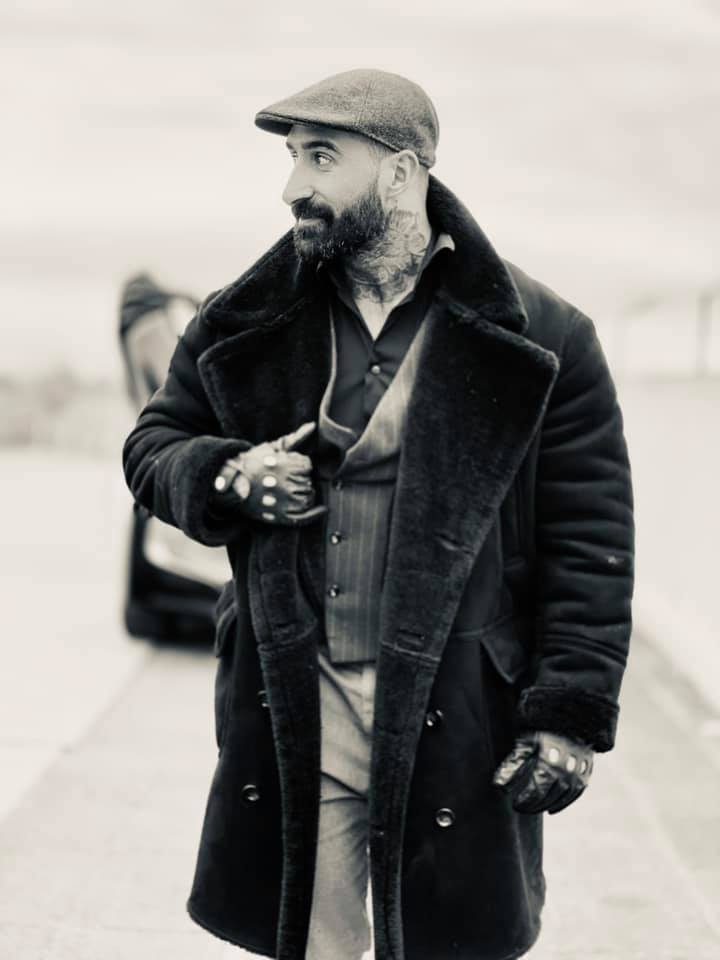
The symbol of success.
The excitement of that day was real. So was the joy. It just lasted as long as these things usually last: not long. And the danger lives here. Not in having achievements, which are actually good and feel good. The danger is in expecting an achievement to fill an emptiness that cannot be filled from the outside. When the excitement fades, the emptiness is still there, waiting for the next one.
From the archive · Without a Mask (2016)
The good thing about not having a mask, among many other things, is having no shame in showing our face as it is.
People may hate it from the start, or they may like it. If they do not like it, they will not stay; if they do, they will stay close even when reality is not so pretty.
That way there is no false expectation of what could be, only what is, with its due margin of disguised madness.
Because we all dance to the music they play us, but the essence of a human being cannot be disguised, not even with make-up.
It is like a natural perfume that the most sensitive noses can detect from miles away. What are we all looking for? People who see us as we are and who not only accept our flaws as they are, but also see in them the reason they love us so much.
So when they point the finger at you and say:
"You're like this," in a derogatory tone.
If it happens to be true, you answer:
"I certainly am, and I love it."
From the archive · Authenticity
Authenticity beats originality, authenticity beats perfection.
Whatever your fears of being judged in the public square, constantly criticised or made an object of mockery, believe me, the earth will not stop, the sun will not stop kissing us with its light and, just as important, nothing that can wound your ego so grotesquely will last forever.
The truth is people could not give a shit about you, they just want something to point a finger at while they forget their own miserable, frustrating existence.
But they quickly turn back to their own dramas, because the numbing effect of judgement does not last long.
So when you set out to create something, do not seek perfection.
Seek authenticity.
Thank me later.
Chapter 4: Let's talk about dopamine
No, it is not the "happiness hormone". That is marketing. Dopamine is, in truth, the molecule of anticipation. It is what makes you want. It is not what makes you enjoy.
And this distinction explains a lot.
It is because of dopamine that you open the fridge without being hungry. That you pick up your phone for no reason. That you say "just one more episode" at two in the morning. It is not giving you pleasure. It is promising you pleasure.
And you chase it. Every time.
It is your brain's reward system. And it was designed to keep you alive. Originally, it was what motivated you to seek food, shelter, reproduction. Essential things. Things that were hard to get. And the reward was supposed to come after the effort.
Except we, clever as we are, found a way round the system.
Today you have access to immediate reward in practically everything. Hyper-palatable food one app away. Infinite entertainment one scroll away. Pornography. Social media. Online betting. All designed to give you dopamine spikes without you having to do absolutely anything to earn them.
And your brain, which evolved over millions of years dealing with scarcity, is suddenly drowning in abundance. It is like handing a no-limit credit card to someone who has never seen money.
Feeling pleasure was never the problem. What goes wrong is pleasure that is constant and cheap.
When you flood the system with frequent, easy dopamine spikes, the brain compensates. Every spike is followed by a dip, and with repetition your baseline keeps sliding down. The system becomes less sensitive to pleasure. This is what is called tolerance. In the most extreme cases, the ones of true addiction, there are actually fewer receptors available for dopamine. But the practical result is always the same: what used to satisfy you no longer does. You need more. More stimulation, more novelty, more intensity. And meanwhile, the things that really matter, reading a book, having a conversation, training, working with focus, start to feel… boring.
You have not become lazy. Your brain is the one that has recalibrated what it considers "interesting". And now, anything that does not deliver immediate reward feels like punishment.
That is why there are people who cannot go five minutes without picking up their phone. Calling it lack of discipline stays on the surface. Underneath is a nervous system used to constant stimulation, which panics when the stimulation disappears.
Now, if you put this together with what we have already covered, the puzzle starts to make sense.
You eat badly? Maybe you have all the information you need. What you also have is a brain looking for fast dopamine through processed food.
You cannot sleep? It may be the infinite scroll before bed, keeping dopamine firing when you should be switching off.
You do not train? You know it is good for you. It is just that the sofa and Netflix reward you now, and training only pays off weeks from now. And your limbic system knows nothing about long-term investments.
You do not meditate? Of course not. Sitting in silence is the opposite of stimulation. For a dopamine-addicted brain, it is torture.
So what to do?
You do not need to go live in a cave. But you can start by noticing when you are being controlled by the system instead of controlling it.
Look at your patterns. How many times a day do you pick up your phone with no concrete reason?
How many times do you open the fridge without hunger?
How many times do you look for distraction at the exact moment something demands your attention?
If you are honest, the number is frightening.
The idea is not to eliminate dopamine. That would be stupid and impossible. The idea is to rebalance. To get your brain responding again to the things that really matter, instead of being permanently numbed by an excess of cheap stimulation.
In practice, that comes down to simple things. Reducing screen time. Tolerating boredom. Doing hard things without expecting immediate reward. Eating real food. Training. Sleeping. Being present.
Yes, they are the same things we have already talked about. Because it is all connected. The body, the mind, the habits, the nervous system. They are not separate drawers.
And dopamine is not to blame for anything. It is a tool, and it does what it is told.
Used well, it is what gets you out of bed in the morning wanting to build something. Used badly, it is what pins you to the sofa at three in the afternoon without understanding how you got there.
What separates one from the other is noticing it.
And by now you already knew the answer would land here.
And here I have to be honest and not put all the blame on dopamine.
I genuinely like learning. I have a conceptual mind, one that wants to understand things through logic and reasoning, and reading is how I do it. I do not even know whether that has much to do with dopamine. Probably not.
But there is a flip side. Sometimes I get trapped inside the concepts. I grab hold of an idea to try to understand reality and, instead of understanding it, I stay in there, going in circles, never leaving my own head. I recently watched a film, Backrooms (2026), that shows this perfectly: infinite corridors, all identical, where a person walks and walks and never finds the exit. On the walls, distorted representations of reality. And there is an image in the film that stayed with me: it is like trying to describe a dog to someone without ever having seen a dog. That is precisely what we do when we try to grasp reality with concepts alone. We end up with a description, sometimes rich in detail, but it never becomes the thing itself. My mind does this to me from time to time. Rooms and rooms of thought, and me in there, convinced the next door is the one that leads to the answer.
And this touches what we have been talking about. It is not always dopamine, it is not always escape. Sometimes it is just the way my head works. But the result can amount to the same: one more article, one more concept, one more lap, and meanwhile life out there, the one lived outside the head, keeps waiting.
In practice
Run a one-week audit. Note down every time you pick up your phone for no reason at all. Do not judge, just count. The number alone will scare you.
Schedule boredom. Set aside moments with zero stimulation: a walk without your phone, a queue without taking it out of your pocket. Let boredom exist without rushing to cover it up.
One meal a day without screens. Just the food. You will notice it tastes better.
Do one hard thing with no immediate reward waiting. Train, read, write. No prize at the end.
Before you go fetch one more concept or one more article, ask yourself whether you already have enough to act. You often do.
Closing question: where does your head trap you, and what is left waiting outside while you circle around inside?
Did you notice that almost everything I propose comes back to the same place? Eating well, sleeping, training, tolerating boredom. It is no coincidence. The body is the shortest way out of your head and back into the world.
The animal that trains itself
Before we close this first part, let me tell you the story of Artur. You will see why it belongs here.
Artur is a white border collie with blue eyes. He arrived at my home during a phase of chaos, the kind where the days feel shorter than the list of things to sort out. On the fifth day, I gave him back.
I did not write "I decided to give him back". There was no decision. I did not sit down to think, I did not weigh anything, I did not look calmly at my life to see whether it made sense. The chaos squeezed and the gesture came out on its own. By the time I realised, it was already done.
I spent the following weeks insulting myself. "You can't take care of anything. You're selfish." Until one day I stopped insulting myself long enough to think, and I went to get him back. But I went to get him with a plan: schedules, rules, training, walks. There was a very strong possibility that what I had lacked the first time had less to do with my abilities and more to do with a system that could hold my life with a dog inside it.
Giving Artur back could have been the right decision. If I had stopped, looked honestly at my life and concluded that I could not give him the conditions he needs, handing him to someone who could was the best thing I could do for him. Far better than keeping him without those conditions just to avoid admitting I could not cope, or to look good.
The gesture was exactly the same: take the dog, hand over the dog. What changes is the place the gesture comes from. Except that cannot be seen from the outside, and that is exactly why, when I told this story publicly, hundreds of people split into two groups, some absolutely certain I was a monster, others absolutely certain I was an example. They were all defining me by a gesture. And the gesture, on its own, says nothing.
What I took from this was a way of looking at these things that I use to this day. In these stories there are always three moments. The moment of reacting. The moment of realising. And what you do once you realise. In my case, weeks passed between the first and the second, and they were wasted weeks, because guilt kept speaking louder than everything else. Reacting, we all react, that distinguishes no one. The question is how long you take to realise. On some subjects I take minutes. On that one I took weeks. It is in that gap that you measure how much awareness you have of each thing. And it shortens with training, we will get there.
In 2002, a psychologist called Wendy Wood did something simple: she asked ordinary people to note down, hour by hour, what they were doing and what they were thinking about. Conclusion: around 43 per cent of what we do in a day is habit. Done almost every day, in the same context, with the head somewhere else. Between a third and half of your waking life runs without you.
The brain has dedicated machinery for this. A neuroscientist at MIT, Ann Graybiel, spent decades peering into an ancient area of the brain, the basal ganglia, while animals learned routines. While the routine is new, the neurons work from start to finish. Once it becomes habit, they fire at the start, go quiet in the middle and fire again at the close. The brain wraps the sequence into a package and stops looking inside it. That is how you manage to drive home while thinking about something else. And that is exactly the price: the package runs whole without consulting you. My fifth day with Artur was not a textbook habit, but the principle was the same. The gesture ran its full course before the question arrived.
How long does it take to install a new programme? There are numbers for that too. In 2010, a team in London, led by Phillippa Lally, followed 96 people trying to build a new habit, each their own. On average, 66 days until the thing became automatic. But what matters is the full range: some needed 18 days and some needed 254. Drinking a glass of water at breakfast installs itself in three weeks. Exercise before coffee can take months. And there was one detail in this study I would like to shout at every client of mine: missing one day did not ruin anyone's curve. Nobody had to "start over from zero". Starting over from zero was always our own invention.
Remember the samskaras, the grooves the wheel keeps digging into the earth until it falls in by itself? Patanjali did not stop at the diagnosis. In the Yoga Sutras, which are over two thousand years old, the recipe comes too: abhyasa, practice. And the text says how: over a long time, without interruption, with sincere dedication. Read that again slowly. Long time. Regularity. It is Lally's study, written twenty centuries earlier, without questionnaires. The path yoga proposes for getting out of your conditioning is chosen conditioning. You open a new groove on purpose and wait for the wheel to start preferring it. There is no trick. There is training.
This is what I wanted you to take from this first part. We have spent four chapters looking at the conditioned animal from every angle, and the conclusion is not "get rid of your habits". Without automatisms you would not make it to breakfast alive. Walking, talking, driving, it is all programming, and thank goodness. The right question is: who wrote yours? The pike could not audit the glass. You can. A dog trained by a person does not choose the training. You choose yours. You choose, you train, the training starts running on its own, and from time to time you realise a programme no longer serves you and you go back in and change it. Consciousness, in practice, is that: it is the one who does the servicing.
A few weeks after going to get Artur back, life gave me the test. I needed to change important things in the structure of my company, and many of them ran through code, something I did not know how to do and had to learn right there, the hard way, with the days once again shorter than the list. A bigger chaos than the first. And this time I stayed on my feet. I solved what had to be solved without dropping the basics: the workouts, the meals, the sleep. And Artur, properly cared for, in the middle of it all. The same me, two bouts of chaos, different responses. Between one and the other, no willpower fell from the sky. There was a system, trained.
Artur stayed. And so did I.
In practice
Anchor the new habit to a routine that already exists. After coffee, before the shower, when you close the laptop. That is how the fastest habits in the London study took hold.
Count on two to eight months for the hard ones. Whoever sold you 21 days was selling. And if you miss a day, you pick it up the next day and that is that. There is no zero to go back to.
Pick one behaviour of yours that runs on its own, what you do when stress squeezes, what you answer when you are criticised, and ask yourself who wrote that programme. If the answer is not you, good news: you just realised. You are already in the second moment.
Next time you react badly, notice how long it took you to see it. Weeks? Days? Minutes? There is no point trying not to react, that does not exist. Shortening the time it takes to realise, that can be trained.
And before giving up on something important, write three calm reasons on a piece of paper. If you cannot write them, you are not deciding yet, you are reacting. Wait two days and go back to the paper. If the reasons hold, quit with a clear conscience, because quitting can also be the right decision. I know what I am talking about.
A question stays with you: the last hard decision you made, was it yours or was it panic's?
What is left is choosing the training ground. The body is the best one I know: the programmes are visible, the results are measurable, and every new groove you open there gives you proof that you can open others. That is where we will begin.
PART IITHE BODY
The minimum requirement.
In 2014, I created T3, the brand I represent today.
T3 stands for body, mind and soul.
The search for that balance became my philosophy of life.
In my opinion, to feel truly whole, we need to develop these three areas.
Each one demands attention.
Each one needs to be fed.
And each one needs to be worked on.
Chapter 5: Let's talk about starting
A few days ago I ran into a friend of mine, all bent out of shape and sleeping badly. "I've let myself go for the last twenty years," he told me. "After I became a father, I stopped living for myself."
I cannot judge, I do not know what being a father is. But I know many fathers who do not put themselves last and manage to perform both roles with some skill: caring for their children and caring for themselves. Because taking care of ourselves has nothing to do with selfishness, it is the opposite. Caring for your body and mind makes you more capable and better prepared for whatever life throws at you, and it is one of the few things that, with more or less difficulty, you can still control. If you are broken, tired, irritable and out of energy, who suffers for it? You, and everyone around you.
But back to my friend. His plan was to go to the gym every day, at six in the morning, before work. Every day, at six in the morning, a man who has not moved in twenty years. That is roughly the equivalent of someone who has not read a book since school deciding to start with Kant's Critique of Pure Reason. In German.
I understand the intention. In his head it makes complete sense to make up for the years of inactivity and the less fortunate choices all at once. There is an urgency, a desire to recover lost time, and that is actually good, it is the first ingredient. What he is not counting on is that the pace of work, the responsibilities, a body that no longer responds like it did at twenty and a biology that could not care less about good intentions will not let him obey that idyllic attempt to chase down the loss.
What almost always happens is this: the person goes all out for a week, maybe two. Then they miss a day, then another, then it starts raining and the gym is far away, then the knee hurts, and the motivation evaporates. A month later they are exactly where they started, except now with the supposed proof that "this isn't for me". But the problem was never the person. It was the plan.
So why not start with something simpler? Build confidence with small promises kept, prove to yourself that you can keep your word, even in minimal doses, and only then, on that base, allow yourself bigger jumps. That way the jumps are made on solid evidence, not on illusions. For every promise you keep, a point in your favour; for every one you break, a point against. And these points count, not to punish yourself, but because that is how you build trust with yourself. Every time you say you will do something and do it, your brain records it. Every time you say it and do not, it records that too. Over time, it is that ledger that defines the relationship you have with yourself.
So, perhaps, instead of going to the gym every day at six in the morning, start by going twice a week. Instead of an hour, do thirty minutes. Instead of signing up for a gym right away, start by walking twenty minutes at the end of the day. It seems little, and it is little. But little done consistently is worth infinitely more than a lot done for one week and abandoned forever.
You do not need to be all or nothing. You probably belong to the majority, for whom going from an eight to a nine, and from a nine to a ten, is already the best thing they can do for themselves and for their people. What is at stake here is simple: being well. Functioning. Having the energy to play with the kids at the end of the day without feeling you are about to crumble, sleeping properly, not being in pain every time you get up from a chair. You do not need to triumph or shine or be extraordinary. For many people, just this would already be a revolution. And it all starts with a ridiculously small step, so small it almost seems stupid not to take it.
I know a thing or two about starting with what you have. I started training at fifteen, with two cement dumbbells I made myself: I filled two tins of canned pineapple with cement, stuck an iron bar between them, and my weights were done. One weighed twelve kilos, the other fourteen.
In my first book I talked about alchemy. I called it The Alchemy of Iron. The idea was simple: iron, training, would be the means through which I took the person I was and turned him into the person I wanted to be, almost like taking something raw and polishing it until it becomes a precious stone. That process rested on a balance that, to me, made complete sense: body, mind and "something more", call it soul, consciousness, spirit, or whatever you like. Hence, in fact, the brand's name: T3.
But it is worth giving some context. What is alchemy, after all? Traditionally, it was the attempt to turn common metals into gold. But it was more than that. It was the idea of transformation, of evolution, of taking something basic and making it into something of greater value. And, if we are honest, there is something inside us that identifies with this: a desire to evolve, to improve, to expand our capabilities, as if we were constantly sculpting a more refined version of ourselves. It does not happen by chance, it happens through choices, through experiences, through the way we react to what happens to us. A half-chaotic, half-experimental process, made of trial and error.
And this is not just philosophy talk. Evolution saw to installing the tool: a complex nervous system, a brain capable of learning and, most importantly, a prefrontal cortex, the part that allows us to plan, reflect and, in theory, make intelligent decisions. Yes, "in theory".
And we are not the only ones with some level of consciousness and choice. There is an animal that tends to surprise a lot of people: the octopus. The book Other Minds explains how octopuses have a highly distributed nervous system, solve problems, adapt and explore, almost as if each tentacle had a life of its own. They are not merely intelligent, they are strangely conscious. Now think about this: the octopus is out there solving complex problems at the bottom of the sea, and you have spent twenty minutes opening and closing Instagram without quite knowing why. No judgement, it happens to the best of us. But it is worth knowing who is giving the orders.
There are two characters bossing you around every day: the limbic system and the prefrontal cortex. The limbic one is that impulsive friend, the one who says "open Instagram", "eat that", "stay on the sofa". It has no patience whatsoever and not the slightest interest in the future, it just wants reward, and it wants it now. The prefrontal cortex is the adult in the room, the one who says "easy now", "does that make sense?", "what happens afterwards?". The problem is that the limbic one speaks louder and gets there first, so very often you do not even get to decide, you just react, and then you are still surprised by the result.
The prefrontal cortex is not on holiday. It just needs conditions to show up: decent sleep, fewer constant stimuli, some training and a bit of room to think. It does not solve everything, but it already helps you stop living in "monkey with Wi-Fi" mode and start having some say in what you do.
And in the context of food, this explains almost everything. Because many of your choices are not born from a conscious decision, they are born from impulse. And until you understand who is at the wheel, you will keep thinking the problem is "lack of discipline", when, most of the time, it is just your brain doing what it was programmed to do.
From the archive · Small Steps (2020)
Day after day I keep taking small steps in the right direction. Having so much left to achieve, so much to be thankful for and so many challenges to overcome makes me feel like a blessed person, ready to wake up every day with a very clear purpose. I look back and, if some years ago someone had told me I would be where I am, the way I am, I might not have believed it. But little by little, and with small steps, my dreams became achievable goals, achieved and raised to another level.
Throughout my journey I saw people climb out of the
"pit" and build a palace on top of it. I saw people who, from nothing, turned themselves into everything, and I drew inspiration from them every day.
If they can do it, so can I. It is the kind of
"envy" one should have in order to build something.
It is a passive, benevolent, empathetic envy, because believe it or not, seeing someone succeed gives me goosebumps, and if that person went through hell to get there… well, then I get emotional.
I hope that, with every victory or failed attempt, I can make the most of it and feel happy with what I do.
It is no use wanting to have everything if, to have it, I compromise my happiness and that of those close to me. So small steps give me greater balance. Small steps keep me in the right direction.
What will your small step be tomorrow?
In practice
Start with something so small you would be embarrassed to tell anyone. Ten minutes of walking, two gym sessions a week, a single set if that is what it takes. This is here so you can prove to yourself that you do what you say. The body comes later.
Make a minimal promise and keep it. A small promise kept for a year is worth more than an enormous promise abandoned after two weeks.
Mark it on the calendar. For every day kept, a point in your favour. The point is not there to punish you when you fail. It is there so you watch the tally grow when you get it right.
Only increase when the base is solid. The bigger jumps are made on solid evidence, not on illusions.
Closing question: what is the step so small it would be ridiculous not to take it tomorrow?
Chapter 6: Let's talk about food
Taking any ideology, moralism or philosophy out of the equation.
Food is, at its base, a way of nourishing the body. The goal is simple: to provide energy and nutrients that allow the body to work effectively.
And, to be completely honest with you, that is how I see it. Rationally.
But reality is not that linear.
For most people, food is not just function.
It is also something social, cultural, a source of pleasure, a form of immediate gratification and, at times, a form of compulsion.
In other words, we do not eat only to nourish the body.
We eat out of habit, out of context and out of emotion.
And this is where the problem begins.
Because when function stops being the base, choices start drifting away from what really matters.
The question is this:
What is your intent with food?
Do you want a body and a mind that work well?
Do you want to improve your body composition?
Do you want to gain muscle mass?
Or are you just using food as an escape, without much awareness? Because if that is the case, the result is predictable: instead of giving you energy, food starts doing the opposite.
More tiredness. More lethargy. More accumulated weight.
Less capacity to function.
"Healthy" foods are, in practice, the ones that give you nutrients. Simple things the body can use.
Highly processed foods, on the other hand, tend to have some interesting characteristics.
They are easy to eat, they taste very good and they make you want to keep eating. Now put that together with two basic ideas: every food has calories, and every food has a different impact on satiety. There are foods that leave you satisfied with little.
Others… it seems they have barely started and they are already gone.
Researchers at the NIH, in the United States, took twenty people and had them live in the laboratory for a month. In some weeks they were served ultra-processed food; in others, unprocessed food. In both cases they could eat whatever they wanted, freely, without limit. And here is the care taken in the study: the food on offer was matched down to the detail, the same calories per gram, the same fat, sugar, salt, protein and fibre. On paper, what they had in front of them was equally caloric in both phases. The difference lay only in what each person, of their own free will, decided to eat. Faced with the ultra-processed food, the same people served themselves more, swallowed on average five hundred extra calories a day, and gained weight. Faced with the unprocessed food, they ate less and lost weight. And they even found out why: the ultra-processed food was eaten faster, and the hormones that tell the brain "that's enough" could not keep up with the pace. Nobody forced them to eat more. The food itself was designed, down to the detail, to get them to eat more before the body had time to say enough.
Yoga never counted a single calorie. It starts somewhere else, from a fact we easily forget: what you eat becomes, literally, you. Your cells, your blood, your brain are built with the material you give them. As Sadhguru likes to say, what you put in the tank decides how you run. And yoga asks you a different question from the scales. Instead of "how many calories does this have?", it asks "how do I feel after eating this?". If a meal leaves you heavy, slow, in need of a nap, your body is wearing itself out digesting it, and you have less energy left for living. If it leaves you light and awake, you chose well. Fresh, simple food, the kind that still has life in it, tends to leave you on that side. Eat what your body can use, not what clogs it. The scales tell you in numbers. The body tells you in the way you feel.
With this in mind, if the goal is a body and a mind that work well, the rules are these: avoid excess calories, give priority to simple, nutritious food, do not graze constantly, let the body digest properly, cut down on highly processed foods. Nothing you did not already know.
But also nothing that most people do consistently.
Now, if on top of that you want to change your body, another variable comes in:
calories adjusted to the goal. Want to lose weight?
You have to consume less than you burn. Want to gain muscle mass? You have to consume slightly more than you burn. The common mistake is going to extremes. Cutting calories aggressively, or eating everything in sight "because you're bulking".
In both cases, one thing starts to fail.
A well-nourished body (and mind), with energy, working as it should.
Protein
No, you do not need to carry a shaker around like life support. But it is also not wise to act as if this were irrelevant.
Protein is, basically, what your body uses to maintain and build muscle mass, recover from training and, while we are at it, help you not walk around hungry all the time. And that last one alone would solve half of many people's problems.
Unlike other foods, protein tends to satiate more. In other words, what you eat counts, but how long it keeps you settled counts as much or more without going to open the fridge every 20 minutes "just to see what's there".
Now, without exaggeration: there is no magic in protein. You will not wake up more defined just because you had chicken for dinner. It does not speed up your metabolism absurdly, nor does it turn anyone into an athlete overnight. But when it is missing… it shows. And it shows fast.
You start losing muscle mass more easily, you recover worse, you get hungrier and, suddenly, what seemed like a minimally controlled plan turns into chaos. It is funny how many people try to solve that with more willpower… when they are actually just eating badly.
In practical terms, there is a simple reference: something between 1.6 and 2.2 grams of protein per kilo of body weight.
And no, you do not need to get creative. Meat, fish, eggs, dairy… normal food. If you want to include a shake, great. It is convenient, not mandatory.
Nobody gains muscle just by drinking protein powder, the same way nobody gets in shape just by buying new trainers.
If your calories are minimally adjusted and your protein intake is decent, you are already doing better than most. The rest is detail, except a lot of people waste time on details while ignoring the basics.
In practice
Build the plate around simple food: a source of protein, vegetables, a source of carbohydrates and some good fat. Nothing complicated.
Aim for 1.6 to 2.2 grams of protein per kilo of body weight. Meat, fish, eggs, dairy. A shake if it is convenient, but it is not mandatory.
Cut down on highly processed foods. Do not ban them, just do not let them be the base of your diet.
Do not graze all day long. Give the body time to digest between meals.
If you want to change your body, adjust calories to the goal: less than you burn to lose, slightly more to gain. No extremes.
Closing question: what is, honestly, your intent with food, to nourish yourself or to escape?
Chapter 7: Let's talk about exercise
Your body has the ability to move itself around, lift weights, jump, run, fight. Being able to do all this is a privilege, even though nowadays many people see it more as punishment. And there is a simple rule: any function of the body that is not worked eventually gets lost. If you do not use your muscles, the body withers and they become less and less capable. The opposite is also true. When you stimulate them, you give them a reason to stay, and when you subject them to an effort they are not used to, they adapt. You can become more capable or less capable, more functional or less functional, and the choice, in good part, is yours.
Lifting weights is not just for getting muscular. To me it is as mundane and as important as brushing your teeth. It has a direct impact on your health and on the possibility of having a body that works for you instead of against you.

Five years of training.
How many times, and for how long? This is where individual variation comes in. What is your starting point? How much time do you have available? Do you have access to a gym, or at least to some equipment? If it is something you enjoy and have time for, it is natural to want to train almost every day, even though you do not need to. If you are starting out and the mere idea of lifting a weight scares you, two thirty-minute sessions a week are already a good starting point.
Alongside strength training, cardiovascular exercise is equally important. And here is a tip: if you choose an activity that genuinely sparks your interest, cardio stops being that boring, monotonous thing. Depending on the activity, you even learn something and have a good time with other people who like the same thing you do. Mine, for example, I do in jiu-jitsu. It is an addiction, and I guarantee you I would do two classes a day if my body could take it. I leave with the task done, wiser and more dangerous. For you it might be surfing, football, padel or anything else. And if for some reason none of that is possible, you can always walk, run or cycle. As a last resort, buy a twenty-five euro exercise bike, put it in front of the television and do your cardio while watching a series or a documentary you enjoy. Adjust the total weekly time and the number of sessions to your availability. Do whatever it takes, but move.
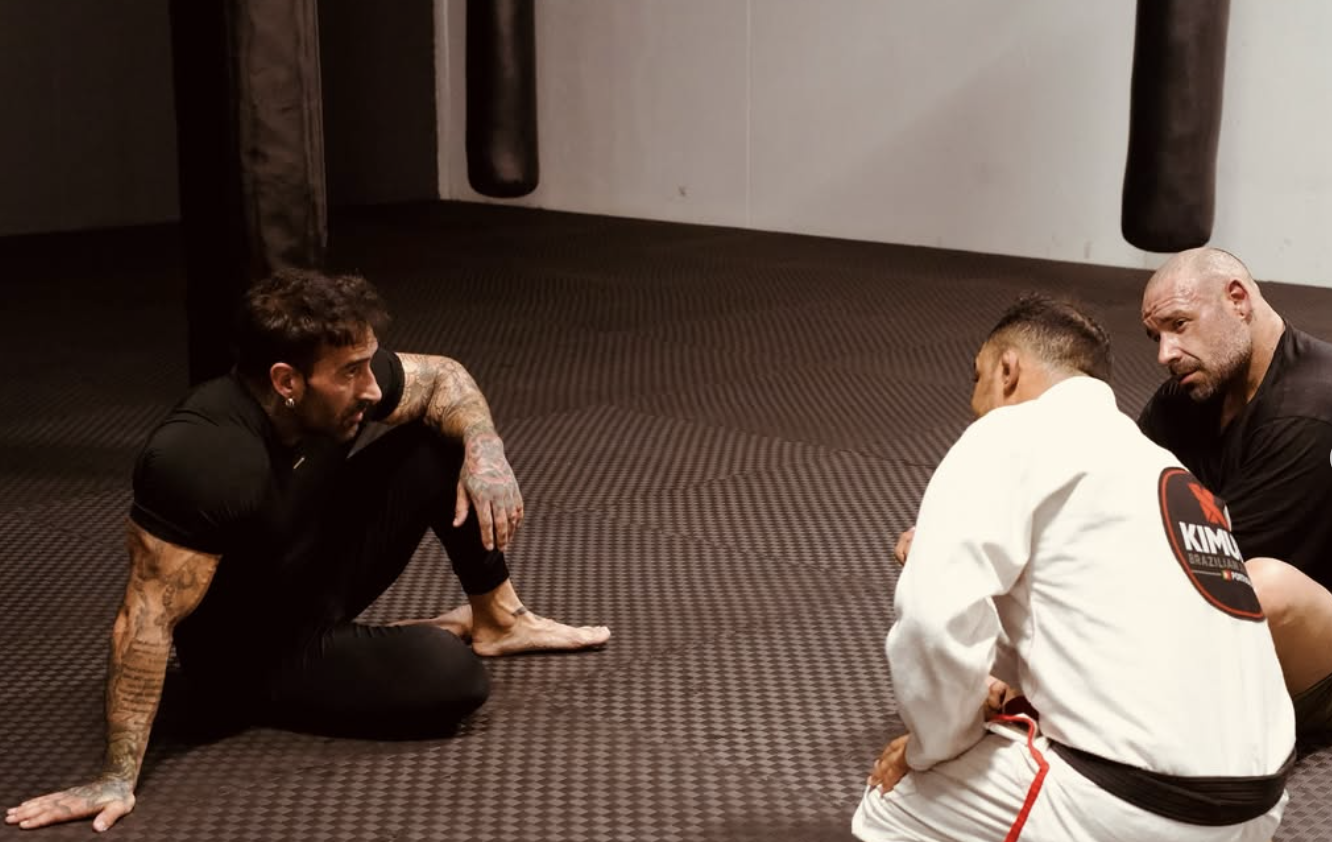
My cardio: jiu-jitsu.
This is not just about muscles, health, longevity or motor function. It is about preparing the ground for a life well lived. Because the impact of exercise on your well-being has been measured, and more than once.
In 1999, a study led by James Blumenthal and his team at Duke University became known as the SMILE study. They took 156 adults diagnosed with depression and split them into three groups: one did only exercise, another took only sertraline, one of the most prescribed antidepressants in the world, and the third did both. After sixteen weeks, the three groups had improved similarly, meaning exercise was as effective as the medication. But the most interesting part came in the ten-month follow-up: the relapse rate was 38 per cent in the medication group and only 8 per cent in the exercise group. Those who only trained not only got better but held on to that improvement far better than those who took pills.
In 2023, a meta-analysis published in the British Medical Journal, which looked at more than a thousand studies with around 128 thousand participants, concluded that exercise was 1.5 times more effective than medication or therapy in treating depression and anxiety. If that is still not enough, here is another, published in 2024, which analysed 218 clinical trials and more than 14 thousand participants, with different types of exercise, from cardio to strength to yoga. The conclusions were solid: physical exercise significantly reduces the symptoms of depression.
Now, if you are on medication, my advice is not that you simply stop taking it. I am only telling you that physical exercise carries enormous weight in your life. And for that impact to happen, you need consistency; going for one week and stopping the next is not enough. So adjust the practice to what you can sustain over time. But if you are smart and have the chance, adjust your life so that exercise is a constant.
The opposite scenario to what I am proposing is this: spending the whole day sitting, climbing three steps and getting tired, not being able to hold your child because your muscles are weak, not living long enough to see them grow, and being in constant pain, to the point where any walk feels like a marathon. It is a shit scenario, is it not? So, if that is your case, do something about it. And if you already have the habit of taking care of yourself, if you already see exercise as something fundamental, great, let us move on.
Before we move on, let me tell you where a lot of this comes from. Because exercise, for me, was never just training. It was school. I learned more about people, about discipline and about myself inside a gym than almost anywhere else. And some of those lessons arrived in the strangest possible ways.
Gym stories
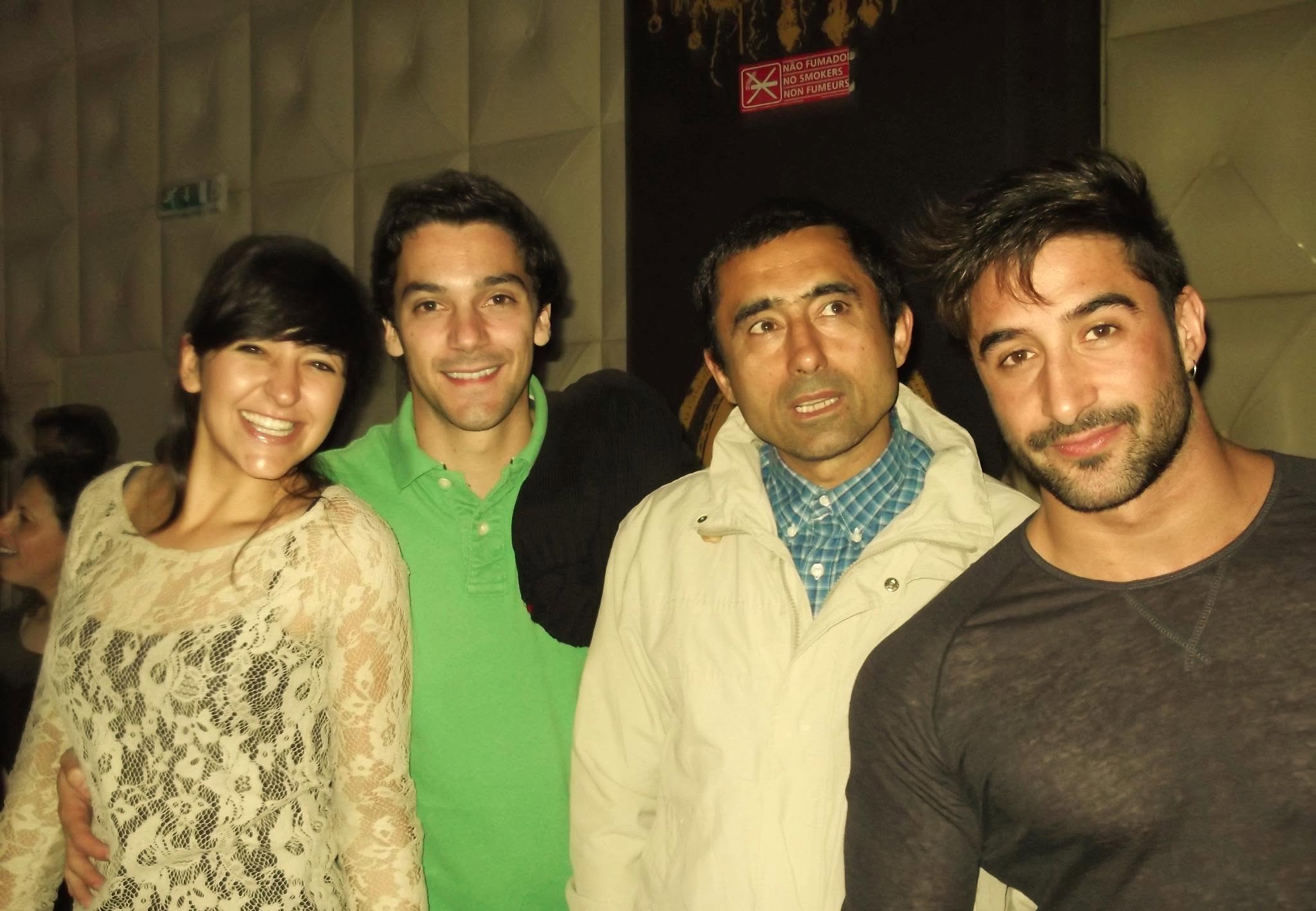
Nelson Gym.
For 5 years I worked at this gym. If I were to put down every escapade here, one book would not be enough.
I adopted a second set of parents in that phase of my life.
Sónia and Nelson (the owners) were as mad as they were extraordinary. I have never met people like them since. There were moments of argument, of laughter, of learning, of helping, of sadness.
The full range of emotions. From one extreme to the other.
I feel deep gratitude for everything lived there. Maybe one day I will write about the adventures of that time.
For now, I will just tell you it was one of the jobs I most loved having. Floor instructor.
We guided people, showing how each exercise was done and which ones to do.
I had no "authorisation" to help the more experienced members. "Those already know how to train," Sónia and Nelson would say. But we found ways to operate in the underground. Hidden behind a pillar, signalling which exercise experienced so-and-so should do, how many sets and reps.
There were queues of people signing up for the gym. The price was friendly, so was the space, but I like to think that my floor coaching, along with Fred's, had a positive impact on the gym's success.
Nelson would sometimes knock holes in the wall to make the gym "bigger". He would look at me with a doubtful expression, like someone wanting my approval for the massive mess he had just made. And I would settle it with a: "Looks great." Later, when Sónia saw it, I would take the blame for that work of art. "It was Tiago's idea," as if I had any say in the matter.
That was me, doing more than I was paid to do, carrying the blame. Good times!
One day a woman showed up at the gym wanting to compete. She asked if I could coach her. I had no idea what that involved, but I accepted.
I promised to give 100%.
I studied everything I could: diet, supplementation, contest preparation. For weeks, I practically lived for that prep.
On the day of the competition we received our "trophy" in the form of words.
Master Waldemar Guimarães was there.
He came up to us in the changing room and said:
"Excellent work. In my book you are first or second place."
We did not make the Top 6, but we left satisfied.
This happened right at the start of my journey as an athlete… and also as a coach.
I contacted a Spanish coach to mentor me.
He told me to come and meet him in Huelva. I said yes.
Simple.
Now comes the part where you realise that, at the time, I had two very strong characteristics:
a desire to learn… and a certain lack of good sense.
I got on the first train to Lisbon without wasting much time researching the best route. Logistical planning was not exactly my strong suit.
From Lisbon I caught a bus to Faro.
From Faro I caught another bus to a small town whose name I could not tell you.
It looked like one of those tourist towns that are packed in summer… but at that moment it was empty.
It was three in the morning.
There were only two people on the street: me… and two drunks.
I was already mentally prepared to sleep on the street when I found a guesthouse where I managed to rest for two hours. It was the equivalent of a five-star hotel at that moment.
In the morning I woke up, caught a boat to Spain, then a bus… and finally a taxi.
A little Iberian excursion.
When I reached my destination, I did a training session with the said coach.
He taught me a few training techniques… and gave me a proper beating.
After the session, belly full, I ended up curling up on the street, in the doorway of a building. I was sheltered from the cold, covered only by the two or three jumpers I had brought.
I was cold.
But I slept.
I woke up after dark, in time for the second session.
And took another thrashing.
After the session, the man was kind enough to take me to a guesthouse where I could finally sleep like a civilised person.
Later I discovered something curious:
there was a direct bus from Coimbra to Huelva.
I could have spared myself half the adventure.
But the truth is that never bothered me.
I made the most of every second of the trip, and all the knowledge I gained in that period is still with me today.
The degree is a foundation.
Additional courses are excellent.
But where you, physical education students and aspiring coaches, really learn, and learn things that rarely appear in books, is with people who have lived in this world for many years.
And, very often, they learned on their own skin what they will later ask others to do.
Maybe you will not need to sleep on the street like I did.
But the desire to learn has to be so big that, if it happens… it is not a problem.
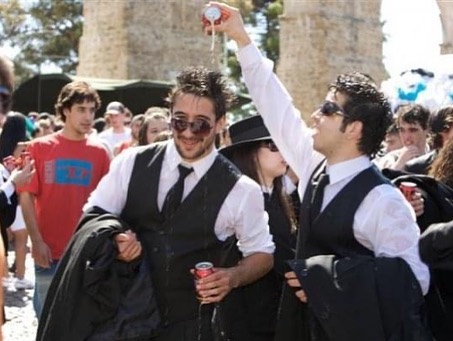
The Coimbra years.
From the archive · This Text Is Not Motivational, It Is Rational (2019)
Life is a game. Not a simple one, but an interesting one.
And if we all knew how to play, we would be much happier.
Knowing how to play means knowing how to accept the problems we choose and telling the ones that do not matter to fuck off.
I apologise for my language, except I do not. If you exchanged two words with me, mine might well be slang.
It is not just the northern air. It is my rebelliousness mirrored in my tongue.
Maybe the pursuit of happiness is a mistake in itself.
For it is only one side of the coin.
Challenging, exciting, full of highs and lows.
Not everything is good, not everything is bad. And what is good and bad is relative.
Everything around us comes with a price. "How much are you willing to pay?" is the real question.
Are you capable of falling in love with the process even knowing it carries pain?
Do you want a good body?
You have to submit to the discipline of training and the detailed organisation that controls your day and your life. It is neither good nor bad. It is the price.
Do you want to be a businessman?
Are you willing to travel to close deals, to sit in meetings on match days, to spend hour after hour focused on a project? To lose nights of sleep…
Do you want to be a successful coach?
Are you prepared to deal with the mental inconstancy of some? With the fact that some need a father figure, to patch the gaps left by their biological one or to validate something that causes low self-esteem?
Something not even a respectable follower count can fill. Or even to deal with the bruised-ego spite of other colleagues who feel they must always have something negative to say about you?
All of that should be weighed. If we can accept the bad and turn it into leverage, if we accept the exacerbated narcissism of the human being with its full range of flaws and qualities, everything becomes more interesting. Because it is the other side of the coin that makes us grow.
If that side scares you that much or blocks you from acting, it is because you do not want that image, the one that pleased you so much at first, all that badly.
In practice
Do strength work at least twice a week. If you are starting out, two thirty-minute sessions are enough to get going.
Choose a cardio you genuinely enjoy. Jiu-jitsu, padel, football, surfing, or a twenty-five euro bike in front of the television. If you enjoy it, you will not skip it.
Adjust the amount and the frequency to your real life, not to the ideal life you do not have.
Above all, consistency. Little done every week beats a lot done in one week and never again.
Closing question: what way of moving your body could you, honestly, keep up for years?
Chapter 8: Let's talk about sleep
Yes, I know. It is not sexy. You cannot post it on Instagram, it does not come in powder form, it does not taste of chocolate and nobody asks "how many hours did you sleep?" in the changing room.
But they should.
Sleep is probably one of the most undervalued things when we talk about the body and performance. Everyone wants to train better, eat better, supplement better… and then sleeps 5 hours as if that were just a logistical detail. It is not.
It is during sleep that the body does a big part of the "real" work. It recovers, regulates hormones, consolidates learning, manages accumulated stress and prepares you for the next day. Basically, it is when you leave "survive" mode and enter "working as it should" mode.
There is a part of this night shift that is almost science fiction. During deep sleep, the brain switches on a cleaning system scientists call the glymphatic system. While you sleep, a fluid runs between the brain's cells and drags out the metabolic waste that built up throughout the day. It is, literally, a wash. And among that waste are proteins, like beta-amyloid, which, when they build up in excess, appear linked to diseases like Alzheimer's. The most striking part is that a single badly slept night is enough for that protein to accumulate further in the brains of young, healthy people, as a 2018 study showed. At the same time, on the other side, the brain uses the night to tidy up: what you lived and learned during the day is filed and transferred to long-term memory. In other words, what looks like dead time is the night shift in which the brain cleans itself from the inside and closes the day's drawers. Sleeping badly means leaving the rubbish uncollected and the drawers open.
There is a tradition that took rest so seriously that it turned it into a discipline, while ours treats it as wasted time. It is called yoga nidra, the "yogic sleep". You lie down, close your eyes and, guided, enter a state halfway between awake and asleep, in which the body relaxes completely, as if sleeping, but a thread of awareness stays awake, observing. It does not replace a night's sleep, and anyone who tells you that twenty minutes of this is worth three hours in bed is exaggerating. But it gives the system deep rest and calms the machine. Maybe it is worth relearning how to rest with the same care with which we learned how to produce.
When you sleep badly, there is no great mystery about what happens.
You end up with less energy, less focus, less patience and, curiously, more craving for junk. Decision-making drifts off with the wind, the limbic system goes into party mode and the prefrontal cortex… well, it shows up when it can.
Then there is that incredible logic: you sleep little, you perform worse, you get more tired, and you decide to compensate with more coffee, more stimulation and less rest. A flawless cycle, if the goal is to run permanently in deficit of everything.
And no, you do not solve this with "willpower".
You may even hold out for a while. But in the medium term, the body collects. And it collects with interest: worse recovery, more difficulty losing fat, more ease in gaining it, less performance in training and a general feeling of always running at half throttle.
In practical terms, most people function best with something between 7 and 9 hours of sleep per night. It is not a rigid rule, but it is a good reference. If you are consistently below that and think everything is fine… you have probably just got used to functioning worse.
And piling up hours is not enough. The body needs the conditions to make use of them. Less constant stimulation, fewer screens at absurd hours, some routine, some respect for the fact that you are not a machine that switches on and off at will.
Because then the classic happens: you want to train well, eat well, think well… but you are constantly tired. And from there, everything else starts to slip.
If you want a body and a mind that work, sleep is at the base, and everything else rests on top of it.
Ignoring this and expecting good results is more or less like trying to build a house on sand.
You may even convince yourself for a while. But eventually… it will give way.
In practice
Aim for seven to nine hours. Call it maintenance, because that is what it is.
Keep a more or less fixed time for going to bed and getting up. The body likes to know what is coming.
Cut caffeine from early afternoon onwards. That five o'clock coffee may be your midnight insomnia.
Take the screens out of the bedroom, or at least away from the last half hour before sleep.
Dark, cool, quiet room. Cave conditions, not nightclub conditions.
Closing question: what if, instead of finding one more way to perform, you started by sleeping properly?
With the body minimally cared for, fed, trained and rested, something precious is left over: energy and clarity. From here, the question stops being about the body and becomes about what you do with what it gives you. And that is already the territory of the mind.
PART IIITHE MIND
The space between impulse and choice.
Chapter 9: Let's talk about meditation
Back in the masks chapter, I left you with a man who had everything that supposedly brings happiness, and who still felt empty. That man was me, dressed as a businessman.
A question was left hanging: if achievements do not fill the emptiness, then what does? It was chasing that question that I ended up in places I never imagined. And one of them was meditation.
But let us start at the beginning, with what made me change course.
The story
I did not like the situation. So I did something about it.
I embarked on the journey of spirituality. A word that comes with quite a lot of baggage and that I use with some reluctance.
Retreats with psychedelics. Meditations. The Bible. Books.
I armed myself with every piece of information I could.
At the same time, there was a mentor who kept telling me:
"Life reflects what is inside you. If we feed thoughts of one kind, reality gives that back to us. Accumulated information is like dust gathering on a mirror. The more dust, the less contact with reality. The more deluded we walk around."
The dirty mirror does not lie, it only distorts.
A mind full of information that has been read, memorised and learned can give the illusion of clarity. But there is an enormous difference between knowing about something and having experience of it. Between having read about pain and having suffered. Between having studied love and having loved.
The more the mind is occupied with what it has learned about life, the less room there is to live it directly.
The dust settles slowly. And often we do not even notice.
It made sense.
The idea that the reality we perceive is fragmented is not new. We see parts of a whole and interpret them based on the preconceptions we have formed throughout life. The probability of drawing wrong conclusions, and acting on them, is enormous.
It is often said that in any situation there are three versions: the other person's, mine and the real one.
To truly understand each other, it would be extraordinary to reach the real version.
But maybe that is unrealistic. What falls to us, then, is at least to understand that there is a high probability that our interpretation is wrong.
All of this sounds very philosophical and not very applicable.
You are right. I felt the same.
But the concept behind it was simple.
We are the awareness that observes the emotions, thoughts and feelings that arise in us.
A more developed awareness can notice those emotions, which we do not control, observe the thoughts, which are often automatic, and from there choose the actions best suited to each situation.
I do not know whether it necessarily works in that order. And I run the risk of simplifying something far more complex. But that this awareness exists is consensual in the literature. It is what allows us to have a subjective experience of the world.
The depth of that forces us to ask: what is this awareness, after all?
For neuroscientists and biologists (the correct word would be meta-consciousness), it is the result of a sufficiently complex brain and nervous system. A by-product of evolution.
For mystics, and for practically all religions that share this belief and do not deny the role of evolution, it would be the soul, the spirit, an extension of God.
Could both be right?
I have no answer. Maybe nobody does. Only doubts.
What I am certain of is that this period brought me something I had longed for.
A background peace, an openness, something different…
I cannot tell you how it happened or what awakened it. I only know it is real. That it accompanies me day to day. That there are days when I feel it more strongly, others when it is more subtle.
But it is there. And it feeds above all on silence and presence.
Reducing mental noise is not simple. And the more we try to fight our thoughts, silence them, ignore them, the worse it gets.
Meditation taught me to observe them. Without trying to contradict them, block them or judge them. To see them for what they are: thoughts.
Nothing more.
And it also taught me to take the ones that serve me and develop them with some clarity and logic.
For that, it is fundamental, and I speak only from personal experience, to avoid constantly hunting for stimulation in an uncontrolled way.
Whether it is entertainment, food or any behaviour that pulls towards compulsion. It does not mean giving up living.
It means being able to appreciate the subtleties.
Setting aside time for what matters to me.
Making sure that peace is a priority.
The care with stimulation applies to the body as much as to the mind.
If you eat hyper-palatable food in excess and often, you quickly lose the ability to savour something as simple as a piece of fruit.
If you spend the day consuming social media, you lose the ability to be in silence. To enjoy the company of the person next to you.
I still feel every emotion intensely, pleasant or not. I have a tendency towards compulsive behaviours, the hunt for information, for example. Even study can be a compulsion. A need to have all the answers. Especially when it serves as an excuse not to do what really needs to be done.
"Just one more paragraph and I'll get to it."
Criticism bothers me. Judgement. I hate confrontations and, when they happen, my instinct is to go on the attack.
I am quite selfish. That brings me good things and less good things.
I isolate myself often. Being around many people leaves me exhausted.
I need a clean, organised space for my mind to work well.
Making sure I eat well, that I exercise, that I have my moments of leisure, of indulgence, and my basic needs met.
That is indispensable for everything to work.
But to a certain extent, and with all of that considered, I manage (more often than before)
to involve myself fully with life without getting entangled in it.
In other words, these days I have a say in the experiences I want to have. And they are lived, most of the time, with such a state of presence that something simple feels like the experience of a lifetime.
But you do not need any of what I have told you to start. You do not need retreats, psychedelics, or years of reading. The entry door could not be simpler: you just need to sit down and stay still. That is where you start.
The practice
Before you start imagining incense, mantras and spiritual retreats in the middle of nowhere… easy. You do not need to become a monk or sit in lotus position for hours trying to "align energies".
Meditation, in practice, is much simpler and much less romantic.
It is learning to be present. And, more importantly, it is learning not to chase everything that crosses your mind. Because if you are honest with yourself, your head sometimes looks like a WhatsApp group with no moderator. Random ideas, impulses, distractions… all at once. And the problem is not even that it happens. The problem is chasing all of it as if it were urgent.
Most people live in a constant state of stimulation. Phone, notifications, information, more information, noise everywhere. And in the middle of it all, one thing has practically disappeared: space. Space to think, to observe, to simply not react.
And meditation comes in here. Not as something mystical, but as a tool. A way of training your attention and realising that there is a difference between having a thought and having to act on it. You do not.
If you connect this to what we covered earlier, you start to see the picture. The limbic system is always ready to fire: open Instagram, eat something, avoid what is hard. And you follow, almost automatically. Meditation creates a small gap there, between the impulse and the action. A second in which you can stop and think: "Does this even make sense?"
You will not always choose better. But you are no longer just reacting.
And no, you do not need to complicate it. You sit, you stay silent, you breathe and you observe. Your mind will start firing thought after thought. Normal. You are not failing, you are just seeing, for the first time, how the thing works.
With time, you gain some distance. The thoughts are still there, but they do not drag you as much. And that translates into quite practical things:
more control, less reactivity, slightly better decisions and less automatic behaviour.
Now, it is also not fair to turn this into a miracle cure. Meditating for a few minutes does not fix your life. But it can be enough to start stepping out of autopilot. And when you add that to training, food and sleep, you begin to have some consistency in the middle of the chaos.
If you cannot spend five minutes in silence with yourself, there is a good chance it is not you who is in control.
And meditation is just one way of starting to get that back.
In practice
Start with five minutes a day. Done every day, it is worth more than an hour every now and then.
Sit down, close your eyes and simply observe what the mind does. You are not trying to silence it, you are just getting to know it, maybe for the first time.
That is all it takes to get going. How I deepen this practice day to day, with breathing, posture and the rest, I leave for the silence chapter, further ahead.
Closing question: between an impulse and the reaction that follows there is always a small gap. Can you find it today?
Chapter 10: Let's talk about the game you are playing
From the archive · Don't Breathe. Don't Live. (2018)
"Don't take that degree.
Don't go down that road.
Don't dedicate yourself only to this.
Enjoy life.
Eat this, eat that, eat me.
Don't quit your job. What will you live on?
Don't get into that business. You're too green for it.
Don't quit again.
Go to the meetings.
Play the same game. Everyone does it this way.
Don't spend so much money on this.
Don't open a company. Haven't you heard about the crisis?
Don't leave the company.
You spent so much building this.
Don't move to another city.
You don't know anyone there.
Don't take that trip, it's a risk, a danger."
Most people have never stopped to think about this, but life works a bit like a game. And the problem is that almost nobody chose the game they are playing. We go around trying to win games we do not even like, following rules we never questioned, wearing a character we did not even choose. And then there is that strange feeling of constant discomfort, without quite understanding why.
It usually starts silently. It is other people's expectations, the comparisons, that ingrained idea that "I was supposed to be doing this". And by the time we notice, we are living a game that is not ours.
Goals, in themselves, are useful. They give direction, they work like an end point marked on the map that helps us organise the route. The complication appears when that point on the map is not yours, when you are chasing something only because someone told you it was important, because it looks good, or because everyone around you is heading that way. Not every game is worth playing by you, and, more importantly, not every game fits you.
We have already talked about the characters people wear without noticing. A game you did not choose almost always comes with one of them inside it, and the price is paid trying to force coherence inside a life that does not belong to you.
Many people lose themselves here, chasing goals that are not even theirs. More money, more status, more validation, more something, without stopping to ask the most basic question of all: does this actually make sense for me, or does it only look important? Because when the goals are yours, the effort makes sense. When they are not, the same effort weighs twice as much.
Two researchers, Deci and Ryan, spent decades on this difference between doing things from the inside or from the outside, and gave it a name: self-determination theory. Intrinsic motivation is when you do something because the thing itself fulfils you, because it is aligned with you. Extrinsic motivation is when the fuel comes from outside: money, status, other people's approval. And what the research shows, quite consistently, is that people who organise their lives around extrinsic goals, more money, more image, more fame, tend to end up less satisfied and with more distress, not less. Not that those things are bad. They are fuel that burns fast and leaves the tank empty. The effort weighs twice as much, as I was saying, and in the end it does not even take you where you thought.
I am not saying you should choose everything from scratch, that is unrealistic. But every now and then it is worth stopping and asking yourself what game you are actually playing. And, right after, an even more uncomfortable question: did I choose this, or did I drift into it by pure inertia? From the moment you answer honestly, everything starts becoming clearer, and you realise there are games that fit you and others that never will.
A goal serves one thing above all: giving you a direction, a target in the distance that guides your path. What really matters comes before that, and it is choosing the right game and the character that makes sense inside it. Because you can be the most disciplined person in the world and still be running in the wrong direction. And that, in the long run, always collects its due.
Dharma. It is the word that stayed with me out of everything I went looking for in yoga. Your dharma is your path, what your nature calls you to do, the game that is truly yours. And the Bhagavad Gita says something about it that nobody wants to hear: it is better to fulfil your own dharma imperfectly than to fulfil another's dharma to perfection. It does not even invite you to walk other people's path better than they do. It warns you that that path, however well you walk it, is dangerous for you, because it forces you to live a life that is not yours. Winning brilliantly a game that was never yours is still losing.
I know this because I have played games that were not mine. And, fortunately, I have also had the courage to walk out of them. Three times, to be exact. Let me tell you.
Three exits
After five years working at NelsonGym, I realised that my interests and the owners' interests were no longer aligned.
So I made the decision to quit.
It was a hard decision. It cost me and it cost them. But I needed to think about my future and about what I wanted to build.
I did not know exactly how.
But I knew I wanted to develop my own vision.
I quit and threw myself headfirst into an infinity of possibilities.
By coincidence, or maybe not, I was at the time reading the book Quit Your Job and Become a Millionaire.
I have this habit: I always read the book that best matches the phase of my life.
In moments of doubt, change or indecision, feeding the mind is probably one of the best things you can do.
I will not lie: I felt fear.
But I also felt something very powerful.
Freedom.
In an attempt to open a supplements company, I ended up receiving an offer to work at a highly regarded gym.
I accepted.
The gym already had an experienced, competitive team. Today, looking back, I can imagine what some of them may have thought when I walked in.
Because my entry into the company was not exactly… conventional.
I skipped several steps so I could start working as soon as possible.
It was in their interest.
And it was very much in mine.
Even so, I did my homework: I tried to understand all the mechanisms, the rules and the way things worked.
I felt prepared.
At the first team meeting, we all had to set a sales target for the month.
The average ran between €1,000 and €1,500, mainly because there was already a client base.
My turn comes.
"€2,000," I say.
The room went silent.
Some looked at me with disapproval.
Others with scorn. Others simply laughed.
They warned me that I was just starting, that I needed time to adapt, that I could be penalised if I missed the target…
"2,000. I'm doing 2,000 this month," I repeated.
Fifteen days in, I had closed one client.
One.
I could hear the comments perfectly well and tell what they thought of me.
But I kept going.
Every day I was at the gym at six in the morning.
By around ten I already had a list of contacts to call, sessions to schedule, conversations to have and sales to try to close.
I knew one thing:
I was doing my part.
Sooner or later, the results would come.
On the 31st, I had €1,500 done.
And I still had one meeting booked for the end of the day.
I walked out of that meeting with a €525 contract for the following three months.
In plain English:
you could not have squeezed a sprat up my arse.
In the second month I did €3,000.
In the third month, almost €4,000.
In the fourth month…
I was fired.
A team works well when there are no destabilising elements.
And I was clearly a destabilising element.
I disagreed with several company policies and I also did not much believe in the idea that it was true teamwork. In practice, everyone was quite on their own.
Today I can understand the situation better.
I can see that those rules and that vision were important for the running of the company.
And I can also see that I was not the right person to work in that context.
The firing made sense.
It was time to go back to the original plan: opening a supplements shop.
I did my research and partnered with someone I considered, and still consider, an excellent partner.
His name is Mauro Coelho.
Together we founded MHD, which today is entirely his.
Opening a company with no fixed income can leave anyone slightly… disturbed.
They were intense months.
But, once again, books helped a great deal in keeping my head straight.
I remember reading a coaching book that helped me ask the right questions, find answers and gain strength where I did not expect to find it.
We opened the company.
Looking back, it was an extremely positive year.
We created a competition team, gained visibility and grew together.
But as with many things in life, there came a moment when our visions were no longer the same.
So we decided to go our separate ways.
And I was the one who left.
Mauro continues with MHD today and is very successful.
And I remain happy to have made that decision.
From the archive · Let Me Go (2015)
I realised we do not have to get everything right the first time, or the second.
Not everything is black and white.
Go this way, go that way. Don't do that, you should do this.
Even the well-intentioned voices must be equally drowned out.
Let me err, let me fall, let me try, experiment, decide, observe and conclude.
Above all, let me be myself, with all the madness that defines me, with all the incoherence, foolishness and blindness. As José Régio wrote, in Cântico Negro:
"I don't know which way I go, I don't know where I'm going
— I know I'm not going that way"
Chapter 11: Let's talk about detached intention
I am going to try to explain something that took me time to understand and that, at first, you will probably find strange. Having goals is good, giving direction to your life is useful, knowing what you want is important. But there is an enormous difference between wanting something and desperately needing it to happen. And that is what decides whether a goal serves you or eats you.
When you put a goal on a pedestal, you turn what should be a direction into a condition. It stops being "I want to get there" and becomes "I will only be well when I get there". Without noticing, you have signed a contract with yourself, with some small print that says more or less this: until you achieve this, you do not deserve to be at peace. Read that again.
Now think how many times you have signed that contract without even noticing. With your body, with money, with your career, with relationships. Always postponing your well-being until after some achievement which, when it finally arrives, does not last. And right after comes another goal, another contract, another condition. It is a race with no finish line. Or rather, a race where the finish line moves further away every time you get close.
Let me give you a concrete example. Imagine you want to lose ten kilos and set that as a goal. So far, so good. The problem is that, from that moment on, every time you look in the mirror you only see what is missing. You do not see that you slept better this week, you do not see that you already climb stairs without looking like you just ran a marathon. You only see that there are still seven kilos to go. Then five. Then three. And, for weeks or months, you walk around in a state of permanent dissatisfaction, living for the day when the right number appears on the scales, as if your life only began there.
One fine day, you get there. You lost the ten kilos. You feel good for a few days, maybe a week. You take a photo, you get some compliments. And then? Emptiness. Because, in the end, the number did not bring what you expected, and you already need another goal to justify your existence. "Maybe if I lose another three…" You are like a dog chasing cars: one day it catches one and stands there, staring at the tyre, without the faintest idea of what to do with it.
And this, by the way, is not a flaw of yours. It is called hedonic adaptation: human beings tend to return to their baseline level of happiness, whatever happens. There is a famous study, from the seventies, that compared people who had won the lottery with people who had become paraplegic in an accident. A year later, the lottery winners were not significantly happier than their neighbours, and they even drew less pleasure from the small things of daily life than those who had ended up in a wheelchair. The achievement, however big, is absorbed. Body and mind get used to it, and the ruler goes back to where it was. That is why the next goal never fills you: it was never built to fill you.
The goal was never to blame. The blame was always in the relationship you created with it. There is a different way of operating, and this is where the concept of detached intention comes in. The intention stays clear, you know where you want to go and you do, every day, what is within your reach, with consistency. What disappears is the attachment to the result.
Karma yoga, the path of action. That is the name this has carried for a few thousand years, and the verse in the Bhagavad Gita that sums it up is this: you have a right to the action, never to its fruits. It asks two things of you at once: total dedication to what you do, and an open hand regarding the result. Work as if everything depended on you, and release as if nothing did. Because, in truth, the result never depended only on you: it depends on your effort, yes, but also on other people's, on timing and on a thousand chances you do not control. Clinging to the fruit is clinging to something that, to begin with, was never entirely yours.
It sounds contradictory. "If I am not attached to the result, I lose motivation." Wrong. What you lose is anxiety disguised as motivation, and believe me, they are very different things. When you are attached to the result, any obstacle becomes a threat. A bad day at the gym is a failure, a week where the weight does not drop is a drama, and every small deviation feeds that voice in your head saying "you can't do it". When you have intention without attachment, the same obstacle becomes just information. It did not drop this week? Fine, you adjust and carry on. Your worth is not hanging on that number.
Think of a surgeon. He needs to be completely focused on the intention, which is saving that person's life. But if he is so attached to the result that his hands start shaking, things go badly. The best surgeon is the one who operates with total clarity and steady hands, and not because he does not care, but precisely because attachment does not cloud his ability to act. With you it is exactly the same logic. Do what you have to do, with commitment and presence, but drop the idea that your well-being depends on something that has not happened yet.
Because, if you think about it, the only thing you really have is this moment. The future is an idea, a projection. And if you spend the entire present suffering over something that may or may not happen, you are trading something you have for something that only exists in your head. And that is not called ambition. It is called suffering with good presentation.
Goals exist to give you direction, not to steal your peace. Use them as a compass, not as a condition for being happy.
From the archive · Peace of Mind in a Time of Chaos (2021)
FIRST PHASE I want things for yesterday, the day is short, nothing around me deserves attention and everything can wait, my focus is one and I want results, I want to see a return on the work done, on all these unslept hours, on this mental wear that comes from pressure, it is not sustainable long term but right now this is how it is.
SECOND PHASE After some reflection, and worn down by time and other events.
What I wanted did not arrive in the quantity, in the order or at the moment I dictated, it will take longer than I expected. What do I do? Put my foot on the accelerator? Because blaming someone is out of the question.
THIRD PHASE What is the hurry? Who is chasing you? What are you trying to prove? And to whom?
Do you have the maturity and the skills to steer what you desire? Maybe not, most probably not. The project grows at the pace of its creator.
They are both babies with a need to grow, and that pace is not dictated by me. So I do not give up, I simply accept that it is not in my hands, that what falls to me is only the action, the most perfect action I can perform here and now, without doing tomorrow's work or complaining about what happened yesterday. And while you are at it, take the chance to enjoy the process, because that is what you will love the most, if you allow yourself to open your eyes.
Finally, give it time, be patient and do not seek immediate gratification, that one is far too fleeting and does not satisfy that ambition of yours. Peace of mind in a time of chaos.
In practice
Define the direction clearly. Know where you want to go, that gives meaning to the effort.
Focus on what is within your reach today: the action, the process, the step. That is yours.
Release the result. Not because you do not care: it is that your peace cannot be held hostage by something that has not happened yet.
When an obstacle appears, treat it as information, not as a threat. The weight did not drop this week? Adjust and carry on.
Closing question: what goal are you gripping so tightly that it is already stealing your peace instead of giving you direction?
Chapter 12: Let's talk about experiences
You can travel to the most beautiful place in the world and feel absolutely nothing.
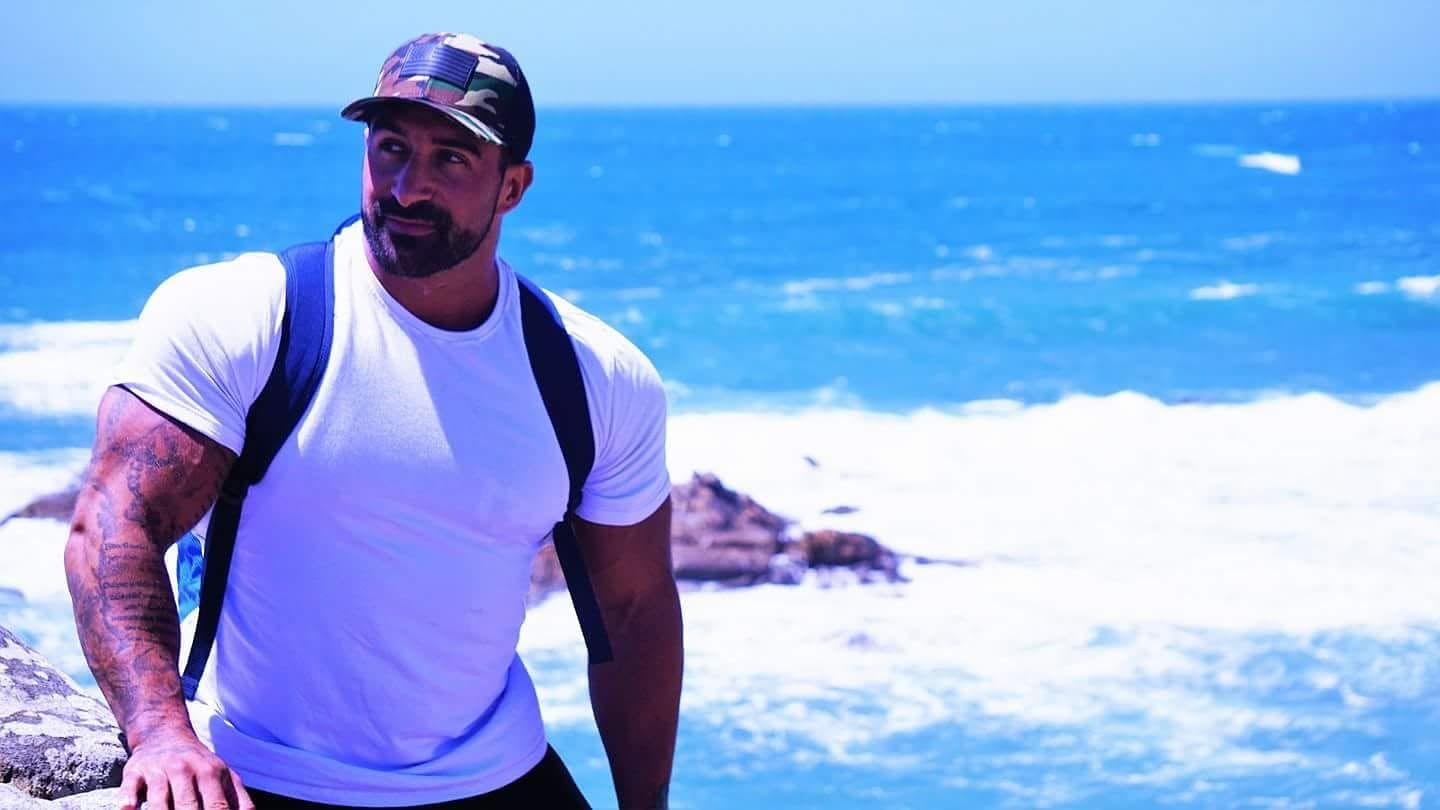
Travelling.
You can stand in front of the most extraordinary sunset that ever existed and the only thing occupying your mind is the unpaid bill or the argument you had yesterday.
It has happened to you, has it not?
You are in a beautiful place, with people you love, and yet you are not there. You are in the past or in the future. Ruminating or planning. The body is in one place, the mind in another. And when you finally
"come back", the moment has already passed.
It is like looking at an extraordinary painting through a dirty pane of glass. The work is there. But you cannot see it. The work is not to blame. It is the glass you are looking through that is fogged.
That glass is your inner state.
This completely changes the way we should look at experiences.
Most people are in a constant race after experiences. More trips. More dinners.
More events. More. As if the quantity of things lived determined the quality of life.
As if collecting stamps in a passport were a synonym for fulfilment.
But it is simpler than that, and more uncomfortable.
What you feel does not come from the experience. It comes from what you carry into it.
If you are full of mental noise, anxiety and restlessness, you can be in the Maldives or in your living room. It will come to the same. The scenery changes, the state remains.
If, on the other hand, there is some inner clarity, some presence, even peeling an orange can be a rich experience. The smell, the texture, the juice running down your fingers. It sounds ridiculous. But try doing it without thinking about anything else and then tell me.
Now, there are moments when this happens almost by accident. And that is when it gets interesting.
Have you ever been so involved in something that you lost track of time? That there was no past or future? That you and what you were doing fused into a single thing?
There was no mind. There was no inner commentary.
There was no "I" observing and evaluating. Only action.
Pure. Clean. Unfiltered.
Some call it "flow". Others call it presence. I call it being properly alive.
A psychologist called Mihaly Csikszentmihalyi spent years studying this state, in artists, athletes and surgeons, people who described losing themselves completely in what they were doing. He called it flow. And the marks he identified are, almost word for word, what I have just described: the sense of time disappears, the voice commenting in your head goes quiet, and action and awareness fuse into one. He also discovered a curious condition for it to happen: the difficulty of what you are doing has to match your ability. Too easy, and you get bored. Too hard, and you slip into anxiety. It is at the right point, between the two, that the thing happens.
Patanjali did not need years of interviews. Right in the second line of the Yoga Sutras he defines the whole of yoga in a single sentence: the stilling of the fluctuations of the mind. That is it, and nothing else. That state in which your head finally goes quiet, in which there is no commentary and no noise, is the destination of the entire practice. The difference is in the how. In flow, you stumble into that silence by accident, dragged by something that absorbs you completely. In yoga, you train to get there on purpose, and to return there when you need to. That is why jiu-jitsu, for me, ends up being meditation disguised as fighting: it is the back door to the same place.
I feel it when I write. When the words come out effortlessly and it is not me writing, I am just the channel through which it flows. I do not think about the next sentence. It appears. And when I look at the clock, two hours have passed that felt like five minutes.
I feel it in jiu-jitsu. When I am rolling with someone and the body reacts before the mind has time to give its opinion. There is no room to think. If you think, you get caught. And that urgency of being present frees me like few things do. There are no bills to pay in jiu-jitsu. There are no arguments from yesterday. There is only you, the other person and the moment.
I feel it watching a sunset. Not the photographed and posted sunset. The other one. The one you watch in silence, alone or with someone who needs no words. When the colours change and something inside you recognises it without needing to explain it.
A sunset, in silence.
I feel it contemplating people. An old man sitting on a bench watching the street. A child completely absorbed in playing with a stick.
A dog sleeping in the sun, without the slightest existential worry. There is something in those images that pulls you into the present, if you are available for it.
And what do all these experiences have in common?
They cost no money. They demand no planning.
They do not depend on perfect external conditions.
They depend on one thing only: on you being available. On arriving at the moment without the mental baggage you usually carry.
That is why caring for your inner state is not a philosopher's luxury. It decides whether you see the painting or the dirty glass, and that is the whole distance between living and existing.
Everything we have covered so far, food, training, sleep, meditation, dopamine, they are not ends in themselves. They are ways of cleaning the glass. Of preparing you so that, when the experience arrives, you are there. Body and soul. Unfiltered.
There is an idea here from the psychologist Daniel Kahneman, who even won a Nobel, that helped me sort this out in my head. He says we live with two selves inside. There is the experiencing self, the one in the moment, who feels the sun on your face now and answers the question "how is this, right now?". And there is the remembering self, the storyteller, who files everything into memory and answers the question "how was it, overall?". The problem is that we spend our lives collecting things for the remembering self, stacking up stamps in the passport just so we have something to tell later, and in the process we sacrifice the only one who is actually alive: the one who experiences. And the remembering self is not even fair. It keeps half a dozen instants, the most intense ones and the ending, and throws away almost everything else that was lived.
Because in the end, you will not remember how many things you did.
You will remember how many you felt.
From the archive · You Might Want to Stay Right There (2019)
Living in tomorrow is one of the great diseases of the 21st century. People do not work for today's comfort but for the comfort they might have ten years from now.
So much richness right beside us and we are not capable of stopping to think about what we are missing.
We are caught in that spinning wheel of worries.
Head down, glued to the screen, checking what so-and-so is doing. What they said. Where they went. Who they are with. In truth, as much time is wasted snooping as is wasted showing off what we are doing.
That whole cycle, addictive and depressing at the same time. Add to that all the doubts and worries about tomorrow, and most people forget what could be enjoyed for free and would give us a return a thousand times greater.
Stop for a few moments, breathe, put the phone away, look at what is in front of you. If you like what you see, you will most probably want to stay "right there"; if you do not, it is only a reflection of what is going on inside you.
Maybe you need to look inwards more carefully, maybe you just need to learn to see, to feel and to enjoy.
Either way, this moment is yours.
That is my concept of freedom.
In practice
Choose one simple experience a day and live it without a phone and without hurry. Peeling an orange, a coffee by the window, the walk home.
Notice the senses: the smell, the texture, the sound, the light. That is where the thing happens.
When the mind runs off to the unpaid bills or yesterday's argument, bring it back to what is in front of you.
You do not need to travel to the Maldives. You need to be present where you already are.
Closing question: at the end of your life, how many things will you remember for having done them, and how many for having truly felt them?
Interlude
From the archive · Lessons I Keep Learning… and Relearning (2021)
1. Learn to listen and be the last to speak.
2. Do not seek perfection, but to improve day after day.
3. Be positive, but also realistic and honest about what you should change when something is not going as planned.
It is just a matter of changing the trajectory.
4. Always consider yourself an apprentice.
5. Set priorities.
6. Manage your time so that you spend a large part of your day doing what you were born to do.
7. If you have not yet discovered your gift, it is time to look for it. Stay alert.
8. Whatever your goal is, it cannot interfere with your happiness. Happiness should be our primary goal.
9. Seek to be, instead of to have.
Chapter 13: Let's talk about people
You can take care of the body, sharpen the mind, sit in silence for seven minutes every day. And then all it takes is a family dinner or a misread message to have you boiling in five seconds. People are, at the same time, the best and the worst part of being alive.
You have noticed by now that this book circles one idea: involving myself with life without getting entangled in it. With people is where that gets hardest. And where I have been wrong the most.
Before I tell you about anyone in particular, a number. There is a Harvard University study that has been following the same people since 1938, one of the longest ever run. It started with 724 men, some from wealthy families, others from Boston's poorest neighbourhoods, and followed them year after year, decade after decade, into old age: medical exams, interviews, their whole lives. After more than eighty years of looking at entire lives, the best predictor of who aged happy and healthy was one thing alone: the quality of relationships. Not money. Not fame. Not professional success. The people most satisfied with their relationships at fifty were the healthiest at eighty.
Let me tell you about two friends. They serve as examples of the two extremes.
Friends.
Zé
Zé.
I met Zé in the 10th year of school. He wore his grandfather's clothes, wool jumpers with diamond patterns, the kind we associate with a ninety-year-old gentleman. That was what caught my attention. I went up to him and said: "Got any money saved, Zé? Let's go shopping." We went to the most expensive shops we could find and he wore those two or three pieces religiously for months.
Zé was the chubby-cheeked, cuddly kid, and at some point he decided he wanted to do something about it. To keep him company and give him a boost, I joined the gym with him. At the time I had not the slightest idea of the importance that decision would have in my life. To this day he says, half joking half serious, that he should receive a percentage of my dividends, for having been the reason I ever set foot in a gym. And the truth is I owe him that. And much more.
I thought a physical transformation would do his self-esteem good. Except there was a curious detail: Zé had always accepted himself exactly as he was. Direct, no beating around the bush, to this day. And it was probably that, his directness against mine, that later got us into a serious falling-out.
The excuse was an argument about politics. A subject I honestly do not care about or understand much. But I put on the character of the tooth-and-nail defender of capitalism against a declared communist, and recited things I had heard somewhere without even understanding them. That parrot syndrome, again.
The same Zé who as a kid would mix bread, chewing gum, Coca-Cola and ashtray ashes and swallow it for five euros became a respected scientist, a biologist, who travels from country to country studying earthworms. Studying earthworms! He married, had children, and I was not present for any of those moments. Out of pure stupidity.
Recently I got back in touch with him. But we have not yet returned to the page of friendship we were on before that idiotic argument.
And here the story does not favour me. I lost years of a good friendship defending an opinion that was not even mine, clinging to a character I had not even chosen. The knife of the intellect in the service of the ego, exactly as we discussed. And the price was paid in something money does not buy: presence in the moments that mattered to someone I love.
Carlos
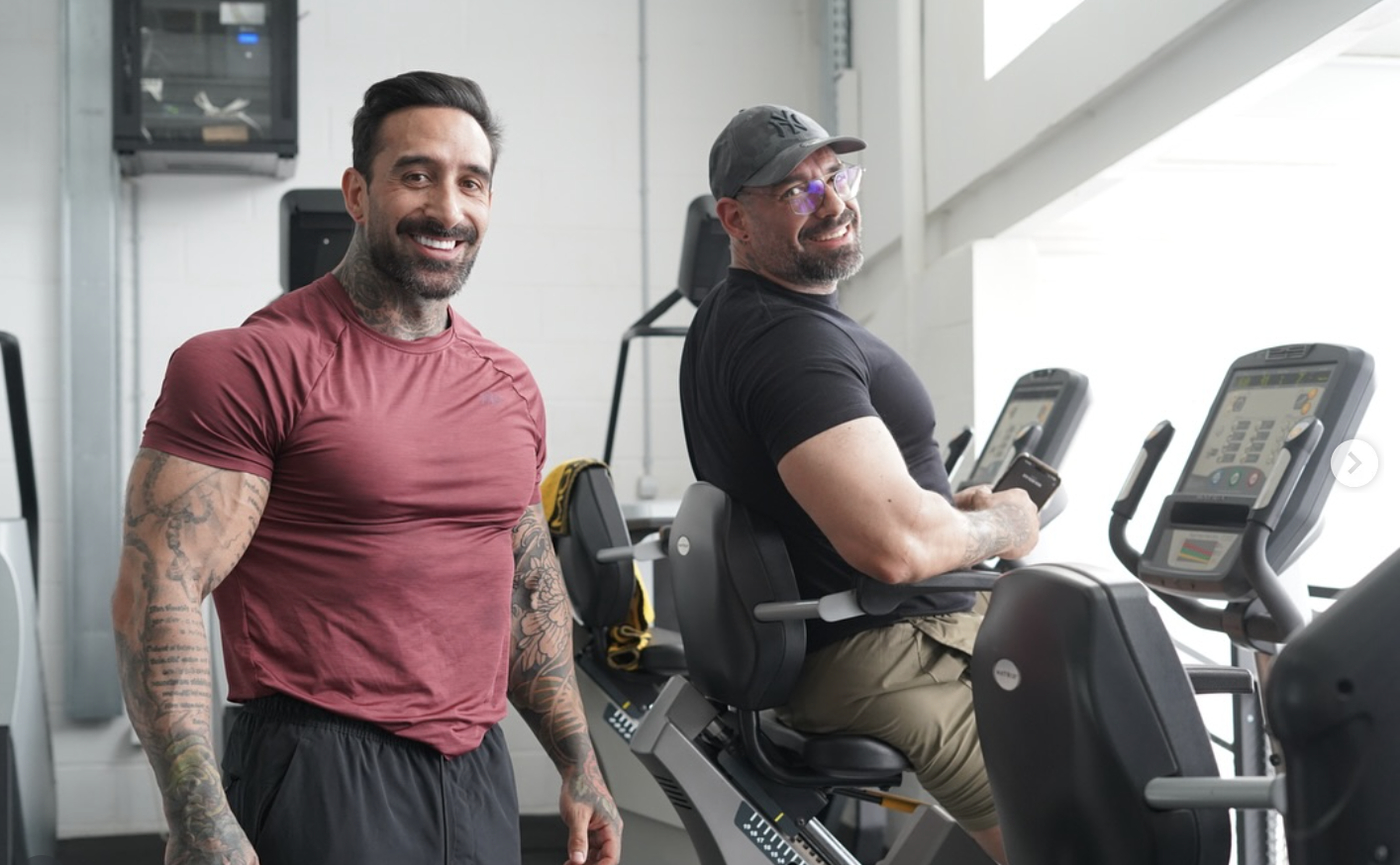
Carlos.
At the opposite extreme is Carlos.
When I decided to dismantle the bodybuilder, stop the steroids, drop that entire life, I consciously cut everything that could pull me the other way. Everything, except Carlos.
Not because he supported me out of self-interest. Because Carlos simply does not complicate what does not need complicating.
Carlos and Inês.
"Carlos, I'm going to travel the world." "Damn, brilliant. Do it, enjoy it. I'll miss you, but come visit me." "Carlos, I'm moving back to Portugal." "Damn, brilliant, now we can spend more quality time together."
Carlos is one of those rare people: if you are well, he is happy for you. Full stop. There are no ulterior motives, no background soap opera, no hidden invoice. Being with him does not cost energy, it gives it back.
With time I understood something simple about people. There are those who add and those who subtract.
The ones who add and the ones who subtract
From the archive · Toxic People
Sometimes they are around us, we do not deal with them directly, but they never miss an opportunity to deposit venom where they can.
They are so toxic that they will never grow or bear any fruit. I will speak of them another time.
Other times they are right in the middle of our circle of action and they wear a mask.
That mask makes us like them, we entrust them with our biggest secrets, our pains, and in the face of our vulnerability their power grows. It grows enough to stop us from moving forward. At the slightest warning sign they pull the rope, down to their level or below it.
They suck energy, love, money and time. We think we owe them this world and the next, and since human beings almost always consider themselves unworthy of better, we are certain that this is the best we will ever have or find.
So better to give in than to fight. That fear of ending up alone, that fear of losing, of changing… it puts us in a crazy, draining loop that will give us nothing good.
"It's for love," says one.
"It's for the history we have," says another.
And so are lost hours of sleep, days of comfort and a lifetime of happiness.
I am not talking about cutting off everyone who annoys us one day. I am talking about noticing the balance. There are people who, when you are near them, leave you lighter, more capable, more yourself. And there are others who, even without much apparent drama, drain you little by little, energy, time, money, peace, and at the slightest threat of losing you they pull you down, to their level.
The hard part is not identifying them. The hard part is admitting that we often stay, out of fear of being alone, because of "the history we have", because we think we do not deserve better. And so are lost hours of sleep, days of comfort and, sometimes, a lifetime of happiness.
That is why the people I let into my life today are as carefully selected as the time I spend with each one. It is not coldness. It is noticing the balance.
Knowing how to apologise
But careful, the knife cuts my way too. Noticing others does not exempt me from being, very often, the problem myself.
From the archive · Apologising
We live making mistakes; erring is our most constant and least conscious habit.
We hurt, without meaning to, without saying a word; it is so easy to hurt that we do not notice when we do it.
The degree may be small for us, but very serious for the other person.
We apologise and err again. That does not change our values, what we believe in, or what we fight for.
We are only human, with all our dreams, with all our inner frustrations, traumas and desires. The mistake itself is part of our learning; we keep banging our head until the pain is big enough to stop us.
But along that learning, things get lost.
One day we hurt someone; another day, we are hurt. The solution, I believe, will come through…
…admitting ourselves as the weak creatures we are, as human and weak as everyone else, opening our arms as if inviting an embrace…
it comes through knowing how to apologise, with the body and with the soul.
We live making mistakes. We hurt without meaning to, without saying a word, and we do not even notice. The degree that is small for us can be very serious for the other person. Apologising, with the body and with the soul, and admitting that we are as fragile as everyone else, is what grown-ups do. I know it, above all, because I have failed at it. Just ask Zé.
And if there is one place where all of this is truly put to the test, the involving without entangling, the balance of people, the ego holding the knife, it is in romantic relationships. That is where I am most capable of the best and of the worst.
Relationships
I have had fantastic women by my side. Women I keep in my heart. If I start scrutinising the reason I ended each of those relationships, I cannot find a logical explanation.
I have always felt that I sail a boat. Every time I let a woman into my life, I know from the start that she will sail with me for a while, but that at some point she will leave. I do not know how to explain it any other way. I do not know if it is a flaw of mine, or just my nature.
And the truth is I do not regret any of the decisions I made, even though the feeling remained. I look back and I am glad it happened. For the memories, for the joys and sorrows, for the trips, for the shared moments. Simple things, but with enormous weight.
And here I have to be honest about something, because it would be easy to sell you this as wisdom. I do not know whether this boat that always slips its moorings is healthy detachment, of someone who involves himself without entangling himself, or whether it is just fear nicely disguised as philosophy. An elegant way of never staying long enough to truly risk. I do not have the answer. But I would rather leave the question on the table than pretend I have solved it.
I do not know if this will change. I do not even know if I believe in love as people describe it.
That romantic movie love looks to me more like a disease, or an addiction, than anything else. "I can't live without you, without you I'm nothing." I may be wrong. But feeling that we are not complete until we find another person does not seem coherent or logical to me.
Finding someone who is already complete on their own, and forming a team with that person, seems far more realistic to me. We are not two halves searching for each other. We are two whole oranges.
Because if I am not complete, I go looking for someone else to complete me. And that almost always leads me to demand that she be the way I want, that she behave in the way that serves me best. Is that the version of love everyone talks about? A transaction. A conditional thing. I love you if you love me too and behave as I want. And if you do not comply, I will set about changing you.
Is that love?
Of course, when two people come together, they have to adapt. A part of each has to die to make room for something new, built together. But all of that is lighter when the two come together because they want to, not because they need to.
Patanjali has a list of the roots of suffering, the kleshas. One of them is called raga, attachment: the tendency to cling to what gives us pleasure to the point of becoming dependent on it, and of suffering the instant it is missing. It is the exact difference between "I want you" and "I need you". Yoga is not asking you to love less, quite the opposite. What it points to is loving without that hunger, without the demand that the other person be a certain way for you to be well. Loving with an open hand, not a closed fist.
I wrote this in 2015, for a woman. Notice how I was already playing the game I question today.
From the archive · I'll Wait (2015)
I shiver when I think, when I imagine you in black underwear, lace, or even in one of my t-shirts and pyjama bottoms.
That is how you are, you look good in rags and without them!
Without paint on your face you are more beautiful, but you insist on spending time dolling yourself up, on bringing out those eyes, those lashes, those lips.
Except they are already plainly visible. And even more so to me, who knows them so well. Not so much from spending a lot of time with my face against yours, but because I have memorised you.
I have memorised your every expression, every tic.
You are transparent to me, like any glass of clean water. I like to believe I know you better than you know yourself; I watch you carefully when you are not looking, so I can pull back when you are paying attention.
That way my façade is reinforced with a few remarks delivered in a tone of mockery, sarcasm, sometimes with affection, sometimes just because I feel like laughing at you! Because we all prefer what fights us and challenges us, don't we?
So this is my way of keeping you close and interested. You end up fighting for an attention you already have, but do not know it!
But fine… put on your perfume, wear that neckline you love so much and do your make-up.
I'll wait.
"I'll wait."
I do not want you to be left with the idea that this is all theory, distance and coldness. Every woman who passed through my life had her own special way of being, and I keep them all with affection. But there is one whose memories are still very fresh.
With her, I ran the world. We lived in Barcelona, in Valencia, in Benidorm, in Vietnam, in Bali. We passed through Bangkok, through Malaysia. So many moments marked me that it is impossible, and I do not even want, to switch those memories off. We had three dogs who greeted me at the door whenever I came home. Today, there is a certain sadness in no longer having that. But being able to feel it is, in itself, a privilege. I smile because it happened.
I learned a great deal from her. I was treated with much love. And, looking back honestly, maybe I was not yet up to receiving it, or to returning it in the same way.
Maybe it was that boat. Maybe it was just the wrong moment. I no longer need to be sure. What stays is gratitude, which is the only thing I make a point of keeping.
In practice
Do the balance exercise. Think of the five people you spend most time with. After each encounter, do you usually leave with more energy or less? Be honest, nobody is watching.
Before defending an opinion tooth and nail, ask yourself if it is really yours, or just your ego holding the knife. It is hard for me, I imagine it is hard for you.
If there is an apology call you have been postponing, you know which one it is. Make it before you finish this chapter.
Closing question: of the people around you, which ones bring you closer to who you want to be, and which ones pull you away? And you? For whom are you the Carlos, and for whom have you been the problem?
PART IVTHE SOMETHING MORE
Awareness.
Chapter 14: Let's talk about loss
I was in the sixth year of school when my mother had to be hospitalised because of a stroke.
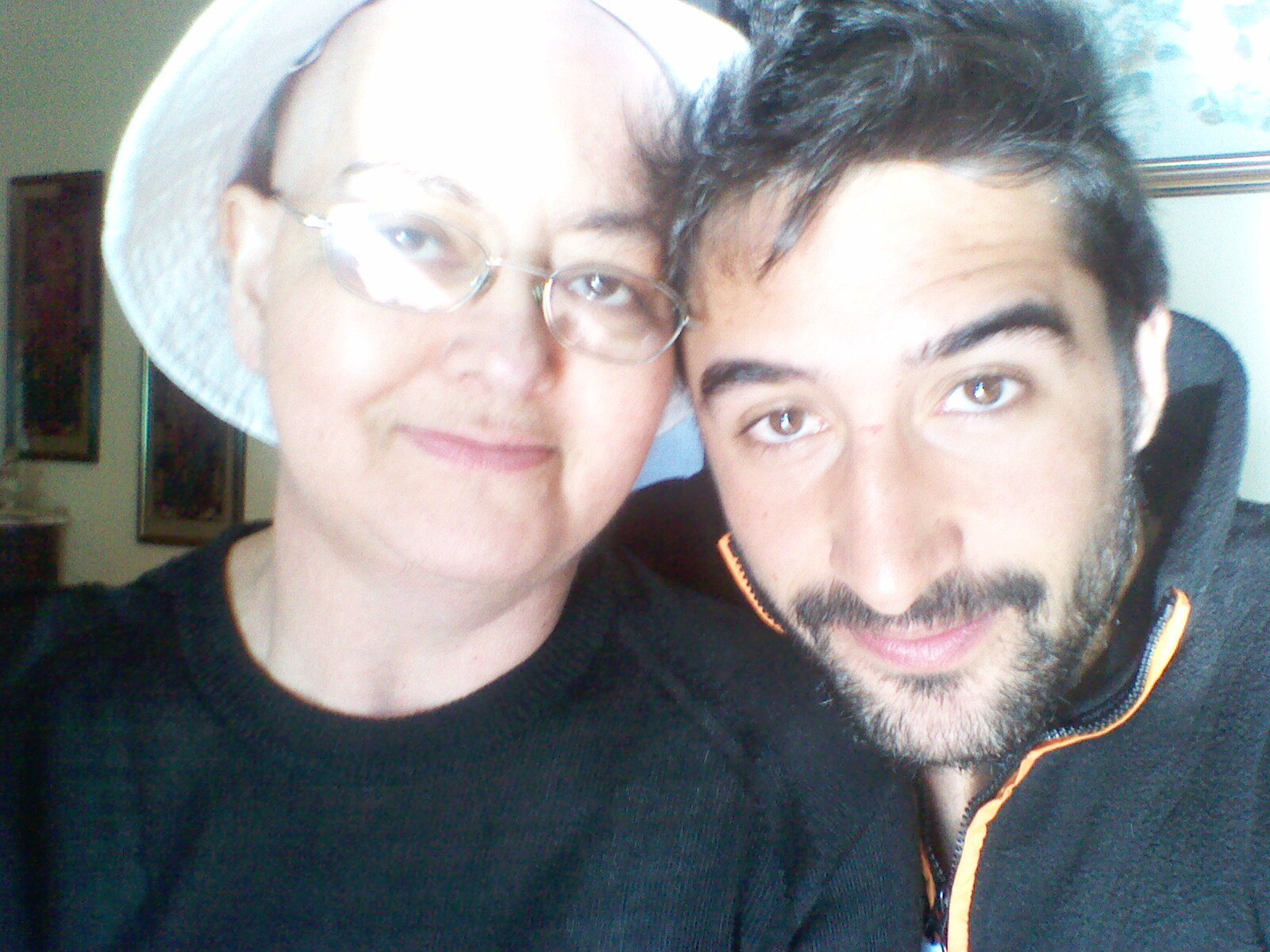
My mother.
It happened during the night. None of us noticed.
In the morning, when we woke up, my father had already returned from the hospital.
He tried to play the situation down. And I did not worry too much either.
I thought it was something quickly treated and that, sooner or later, she would be back home.
At the time I had piano lessons. Ensemble class. Music theory.
And I had a recital coming up.
There was one recital per school term, which served as an assessment.
My mother was still in hospital and it was the first time she would not be present at a moment like that.
I remember it perfectly.
The recital was at 7 p.m. In front of a room full of people.
And I remember not wanting to be there.
Not wanting to play.
In that moment I felt that was not where I should be.
I ended up playing.
Later I learned that, at that precise hour, my mother was having her second stroke.
This time, more serious.
With my mother absent from home, my father, my brothers and I all had to adapt to a new reality.
Conditions became harder.
I went to live with an aunt of mine to ease my father's burden.
It was a strange phase of my life, but I could count on my aunt and uncle's care and on my cousins' friendship.
I ended up taking refuge in a kind of semi-rebellion.
As much rebellion as is possible for a student with excellent marks.
Because, despite wanting to be a bad boy, my marks were irreproachable.
Which, let us admit, takes some credibility away from any attempt at rebellion.
Even so, I did receive a few warnings about my behaviour.
Despite the constant renewal of our cells, I feel that the moments that mark us stay written down somewhere.
No cell renewal can erase our history.
It is these events that give us "life experience".
Especially the negative ones.
They are the ones that make us grow. That force us out of the comfort zone, to look for solutions at a time when none seem to exist.
I have always believed that, in any negative situation, there is a lesson to learn.
A solution to look for.
If we keep some confidence in our abilities and in the possibilities that still exist, we realise there is always something that can be done.
But there are problems in life for which we have no solution.
None makes us feel as weak or as powerless as seeing someone we love ill and suffering.
In those moments there is not much to say.
There is not much to do.
All that is left is to wait.
That was everything I felt when I was finally able to visit my mother.
I knew the problems were related to the brain and I was preparing myself for the possibility that her cognitive capacity might not be working at one hundred per cent.
When I entered the room, she looked at me and asked:
"Who are you?"
She said it with the genuine expression of someone who truly did not recognise me.
"It's me, Mum."
I answered, frightened.
She smiled and asked me for a hug.
Her sense of humour, definitely, had not been affected.
The recovery was slow. With many highs and lows.
She eventually returned home and managed to partially recover her motor capacity.
Tireless housewife that she was, she quickly found a way to keep taking care of the household.
She moved from one side to the other, limping.
It took her an eternity to get anywhere.
But she went.
Thinking about it, maybe it was that attitude that allowed her to walk again.
Even when the doctors told us, with total certainty, that it would never happen.
How could I not be inspired by my own mother?
But when the cross is very heavy, there comes a moment when the body tires.
And the battle becomes too hard.
That is what ended up happening.
After the stroke came breast cancer.
More surgeries.
More appointments.
More doctors.
More moments without her by my side.
And even knowing that questioning these things does not help much… sometimes it is hard not to.
I was in Brazil when I started to sense that something was not right.
Between advances and setbacks in someone's health, there is always a hope that everything will eventually improve.
But whenever I talked to her on Skype, there was a very strong cough that sometimes brought tears to her eyes.
It was not normal.
When I arrived in Portugal, she was in hospital again.
As soon as she saw me, she started crying.
She hugged me and said:
"I will still see you graduate."
She had been diagnosed with metastases in the lung.
Pleural effusion.
Remnants of the cancer we thought we had overcome.
For ten years, which I refuse to reduce to her clinical condition alone, there was much suffering.
But she was still there.
Smiling.
Rosary in hand.
Incredible.
One morning I received a phone call from my brother.
When I answered, there was silence.
Then a few tears.
It was enough.
It took me a few seconds to realise I was awake.
That it was not a nightmare.
Even though I had seen her lower her arms, and knew that moment would come, I still hoped it was just one more phase.
But it was not.
In truth, she did not get to see me graduate.
It was only one month away.
Pain is inevitable. You lose someone close to you and it hurts. Sometimes it hurts in a way for which there are no words. That is life, and there is nothing to be done about it. Nor should one want to. Running from the pain of a loss is running from the proof that the person mattered.
What is no longer inevitable is everything the mind builds on top of the pain. The stories, the narratives, the "why me", the "I should have done more". That part, most of the time, is optional. And it was the one that took me longest to understand.
Because there is an enormous difference between two sentences. "I will never see her again, what a shit life." And "what a privilege it was to have known her, life is beautiful." The loss is exactly the same. The inner experience lived on top of it is completely different.
There was no single day when I understood this. It was not a click, or a sentence I read, or a moment of revelation. It was something that came with time, slowly, almost without me noticing. For a long time I stood on the side of the first sentence. Of the "I should have been more present", of the "if only I had known". I was far away, in Brazil, when she started getting worse, and there is a part of me that carries that to this day. But, with no date marked, the day came when I caught myself remembering her expression more than the illness.
None of this has to do with coldness. The pain is still there, whole, and it should be. What I learned to let go of was the rest, that layer of suffering the mind hangs on top, which no longer speaks of the person who left, but of the stories I insist on telling myself.
And, at times, I had the feeling she was still nearby. Never as much as on a trip I made to Miami.
One of the maddest and most absurd trips I ever took began on 27 January 2017.
I decided to throw a backpack on my shoulders and buy a plane ticket to Miami with a very clear objective.
To find Dave Palumbo, who would later become my coach. I wanted him to see me in person, I wanted to hear from his own mouth whether it was worth aspiring to a pro card. At the same time I wanted to test myself and find out how far my abilities could carry me.
As soon as I arrived in Miami, I ran into my first mishap. The suitcase travelling in the hold had been held up somewhere mid-journey, so I would have to wait one or two days for it to reach me. That would not have been a big problem if I did not sweat like a horse during the flight, and if I had not soaked myself in a puddle of water the moment I arrived at the place where I would be sleeping.
Finding food was not easy either, since the phone charger had also stayed in the suitcase and my GPS was every Spaniard, Englishman and Mexican I kept asking for directions. I can tell you that during that whole trip I must have had two or three meals a day, which for anyone outside the bodybuilding world is utterly banal.
For someone who had to sustain 110 kg and was in an off period from steroids, it is one of the worst things that can happen. But I tried to stay positive; after all, I had plenty to be thankful for.
After getting my suitcase back and having access to my email, I decided to look up Dave's contact and let him know I was there to see him. His reply did not take long. As it turned out, he did not live in Miami, but three hours away.
"Well played, Tiago, you couldn't even look up the exact location."
Let us say that in Portugal, any means of transport would do for a trip of that distance, but not there.
So my friends, after much searching, many questions and much research, I realised there was no transport that would drop me where I needed to go.
So, I improvised…
I caught a bus that left me two hours from the place. On the bus I met a Colombian man who was going near the area and I managed to get a lift with his aunt, leaving me one hour away. After a few kilometres on foot heading towards a taxi rank that turned out not to exist, I managed to get a lift from complete strangers, to whom I am deeply grateful!
Arriving there, I finally managed to access my email, and I saw that Dave had replied, saying he could see me at 4 p.m. at his office. This would have been fantastic news that would have had me jumping for joy, were it not already 7 p.m.
I confess that in that moment I sank. I felt pathetic, having made a trip like that in vain; my financial resources were counted and any step taken from there would have to be very carefully weighed.
I was already resigned to the idea that I had done everything in my power to achieve what I had set out to do. "Maybe I should have thought this through and studied and planned this trip," I was already thinking, trying to console myself.
Resigned, I went looking for a place to eat, since it was 7 p.m. and I had only one meal in my stomach. I found a burger joint where I placed my order and opened my email once more to reread the message I had sent, to contemplate that great failure of mine.
To my great astonishment, I received another email at that very moment:
"I believe we can meet at my house then, here is my address."
Needless to say, I did not even wait for the food to arrive. I grabbed my backpack and hailed a taxi, nervous, anxious, happy. A mix of emotions.
I then arrived at a piece of waste ground, where I could make out the shadows of three houses. Little light and much undergrowth was the scene before me.
"Are you sure that you want to stay here?"
"Yes, I am sure."
I paid and went straight to one of the houses. I followed my instinct, or my feet, I am not even sure.
I knocked on the door of one of the houses, and imagine my astonished face when DAVE opened the door:
"Welcome, crazy person."
I spent about two hours there. I talked with him about many things, heard his opinion on what I was doing, got some advice from him, and we ended up talking about his snakes. He bred them, and I got to watch how he cared for them.
Trip to Miami, 2017.
I was loving every minute. After all, everything had led me to that moment, even the things that had seemed bad.
Of all the scenarios I had imagined, this one had never crossed my mind. So it was a good surprise.
I called the taxi again and, now more satisfied, with a feeling of mission accomplished, it was time to feed the body, for the soul would stay full for a long while.
I ended up having to make a decision: the money would not stretch to everything, so the most viable option was to eat something and look for a little bench to sleep on, and so it was. It was 2 a.m. when I woke up to a shop alarm, freezing, shaking all over and unable to feel my fingertips.
If falling asleep had already been hard, now it would be impossible. At that point, a police patrol arrived, and I hid from them for a few moments, without quite understanding why. They might think I had set off the alarm, who knows.
The cold was so bad that I ended up going over to them in the hope they could help me.
They searched me and called me crazy after I explained what I was doing there. They took me to a waffle house that was open 24 hours, where I could keep warm.
Out on that street, I would certainly have died of hypothermia.
I forgot to mention that my outfit was a pair of shorts, a tank top and flip-flops. Somehow, that alarm had saved my life!
Fortunately I was very well received in that establishment. They recognised me as a
"bodybuilder", and from what I gathered, bodybuilders are very respected there. They paid for three meals for me that night; I got to fill my belly.
What a good feeling. It all felt like a film lived in the first person.
I felt alive and eager to put all those adventures down on paper. So I asked for a napkin and a pen and wrote everything down. Later, around 5 a.m., unable to sleep a wink, someone had the idea of putting a coin in a jukebox and choosing a song.
I was extremely tired, heavy with sleep but unable to drift off, and yet the song caught my attention:
"Just hold on, we are going home"
Have you ever felt protected, guided, wrapped up by a greater force, an invisible force? Well, I felt all of that, and I felt what that force was… it was my mother!
Throughout the whole trip I was guided and protected, flooded with a strength I did not have access to every day. I felt that star watching over me and, at the end of that mad journey, she even sang to me and comforted me: "just hold on, we are going home".
I went hungry, I froze, I went hours without sleep, I slept on the street, I was nearly arrested, I hitched rides, I accepted meals from strangers, I got lost a few times and found myself as many others.
Tears came to my eyes several times, not from sadness, but from gratitude.
I travelled alone, but I felt accompanied the whole trip. Besides achieving my objective, I returned to Portuguese soil with heavier baggage and a smile on my face.
From the archive · Letter to You, Mum (2015)
It is hard to express such gratitude in words.
Today, sitting here in the silence of the dark, hearing only the restless leaves of the trees, I remember you. I remember so many moments, so many opportunities to show you how much I admired you, how much my face grew peaceful watching you smile as you faced that illness.
Your faith, your strength gave me hope even when there was no reason for any. It allowed me to believe even as I said goodbye to you.
Come to think of it, it did not even allow me to see that it might be the farewell, that it might be the last time my hands touched your body with soul.
I feel I could have done more, that I could have spent more time with you.
If only I had known…
Your smile and your eyes were passed on to me, an inheritance that comes with birth, the fruit of a random joining of chromosomes.
Your eyes are the reflection of mine, your smile too.
I engraved you on my arm as a prayer!
Hours and prayers spent and offered rosary in hand, your symbol, the one that set you apart, the strength that kept you standing.
I keep many good things of yours; I keep your hope, the longing, tears that fall as I write you this.
Tears that fall when I remember you, for everything, and for nothing.
I dreamed of you.
You answered a question of mine and you did not need to speak… you did not need to make a single sound.
I woke with the answer in the form of an energy that surged through my body and made me smile the moment I opened my eyes.
I felt you so close to me!
Accept my gratitude, accept my apology for my failings…
I will dedicate to you all my kindest actions. I will strive to make you proud of me.
A longing that kills and is disguised by time, but remains intense…
Knowing I can no longer hug you weakens my heart, and looking at your photograph, I remember you every day.
Not the illness and all the suffering, but your expression, your voice, your warmth…
This is the letter I never wrote you. I feel grateful for the time we spent together, happy to know you will always be by my side.
… but I do it with tears in my eyes.
I do it with longing, with hope and with all the Love I can give you.
See you soon
From the archive · Christmas without You (2020)
And here I am, here he is, and here you all are. Here we are, and you are missing. Forgive me, "you" said properly, with respect.
I was raised to address my elders formally, and she would not allow me, or any of us, to do it any other way. Remember how upset you would get, and how Dad would look at us with that intimidating face? Yes, one looks with the whole face. The eyes alone are not enough.
It is an expression that is intimidating through and through.
I walked in here today and the smell is the same. There are smells, memories and people that are never forgotten. You are one of them, forgive me, formally so!
We are far from perfection. One is playing PS3, two others are on their phones and another is the cook.
Work and to hell with it.
I observe, I write about it, and I note that it is really not the most picturesque scene, but it is undoubtedly beautiful just as it is.
I want to take a mental photograph to remember, a written record to strengthen that memory, and then I promise I will live it.
We deal with periods of silence and periods when nothing much gets said. Nothing that could be said will ever be as pleasant as your shouting, your complaints and your orders. Even so, we are here and we are well.
In a little while it will already be tomorrow, and I promise to leave you a flower before I go, forgive me, to leave you a flower, said properly, before I go.
My mother walked again when the doctors swore, with total certainty, that she never would. She limped, she took an eternity to cross the house, but she went. Rosary in hand, smiling, even as her body was coming apart. That is what stayed with me of her: the serene stubbornness of someone who decides how she will live the time she has left.
Today, when I think of her, I no longer think of the illness. I think of the expression, the voice, the warmth. It took me years to get here. But I got here.
A question stays with you: the losses you carry, do you carry them for the person who left, or for the stories you still tell yourself about them?
Chapter 15: Let's talk about psychedelics
Retreat.
This is not a text to convince you of anything.
I am not going to tell you to try them. Nor am I going to tell you not to. I am only going to share what my experience brought me. And then do what you like with it.
Imagine a centre. Call it soul, consciousness, spirit, an extension of life, or anything else that makes it easier to grasp. The name does not matter. The concept does.
Now imagine that around that centre there is a layer. Made up of your body and your mind.
The stories you tell about yourself. The identifications with characters you have built over a lifetime. The traumas. The repressed emotions. The obligations. The compulsions. The beliefs you adopted without questioning.
The more rigid those stories are, the thicker the layer. The further you are from that centre. The harder the contact with what, for lack of a better word, you really are.
Most people live their entire lives on the surface of that layer. And there is nothing wrong with that. You can function. You can have a life. But something remains undiscovered.
Psychedelics, in no way according to plan, helped me break through those barriers. To make contact with that centre. Not in a controlled or predictable way. Nothing in it is controlled or predictable.
Sometimes, the experiences were about walking through the traumas. Feeling what had been swept under the rug. Things I believed were resolved, but which had only been tidied into a corner. And when you meet them head on, without filter, without defence, you realise they had not disappeared. They were just waiting.
Sometimes, they simply served to observe my own incoherences. How the stories I told myself did not make sense. How certain beliefs I carried with such conviction were nothing more than sentences I had read, heard or memorised. They seemed solid, but when confronted with direct experience, they crumbled.
And at other times, the contact with the centre was direct.
There are no words to describe what I felt in those moments. And I know this sentence is frustrating to read. But it is the truth. It is a sensation that goes beyond what I can think, describe or compare.
Any word I use will fall short. It is like trying to explain a colour to someone who has never seen.
Is that a contact with the creator? I do not know. I do not have that answer. But I know there is something there that is bigger than me. Bigger than any story I could tell about myself.
There is a network in the brain that researchers call the default mode network. It is what sustains what we feel as our "I": the autobiographical narrative, the memories about ourselves, the sensation of being a continuous person, separate from everything else. It is the machinery that manufactures that layer of stories. And what the psilocybin studies showed, above all the work of Robin Carhart-Harris at Imperial College, is that this substance reduces the activity of that network. More interesting still: the greater the reduction, the more intense was the sensation, reported by the participants, of what scientists call "ego dissolution". In other words, when the machine that tells the story of who you are turns down the volume, what remains is the rest. Call it centre, call it consciousness, call it whatever you like. Science describes the mechanism. It does not tell you what you find there. That remains up to you.
Now, not all experiences are what you would consider "positive". Some are chaotic.
Uncomfortable. Confronting. There are moments when you do not want to be there. When the mind fights against what is happening. And that is precisely where part of the value lies. Because the confrontation with what you avoid is, very often, what you need the most.
But regardless of whether the experience was more or less chaotic, there was something that always repeated itself.
In the days that followed, the mind was empty. Clean.
Silent.
Not empty in the sense of absence. Empty in the sense of space. As if someone had opened the windows of a house that had been shut for years. And suddenly air comes in. Light comes in. And everything looks sharper.
On those days, I was a version of myself I can only describe as superhuman. Not in the sense of doing extraordinary things, but in the sense of using the mind fully under my control, instead of being used by it. Every decision was clear. Every action was intentional. There was no noise. There was no drama. Only presence.
That clarity of the following days was not my imagination either. After an experience like this, the brain remains, for a while, more mouldable than usual. The research, done in clinical, controlled settings, shows that these substances promote neuroplasticity, that is, the ability of neurons to form new connections. For a few days or weeks, the brain is easier to reshape than usual. There are even studies that speak of lasting changes: people who go through these experiences become, on average, more open, and that openness can hold for months. But there is a trap here, and it matters. That window closes. The cement dries. And if, while it is open, you build nothing new, you go back to where you were. What you do with that window, while it is open, may be the part that matters most.
And that is where the question that changed everything appeared:
Can I feel this without having to take something?
In yoga no psychedelics are used. But the state I have tried to describe has a name in that tradition, samadhi, and it is not a side effect of the path: it is its destination. A state of absorption in which the sensation of being a separate "I" dissolves and what remains is a unity that does not fit into words. The difference is in the road there. Yoga does not reach that state by chemical shortcut, it reaches it through practice: breathing, meditation, discipline, year after year. And there is a detail that has always fascinated me. In Patanjali's Yoga Sutras, a text thousands of years old, it is written that these states can arise by several means: from birth, through plants and substances, through mantras, through intense discipline, or through samadhi. That is, the tradition itself has recognised, for centuries, that a substance can open this door. It has simply always pointed to the path of practice as the safest one, and the only one that actually lets you stay on the other side.
That question has been bringing me interesting answers. Since I am not certain about them, I prefer not to share them. There are things that need to be lived, not explained. And the risk of turning an experience into theory is losing what makes it real.
But I can tell you this: I have been having glimpses.
Lower-intensity variations of that state, without having to take anything. Moments when the mind does not get in the way. When there is a background silence so vast it leaves you in ecstasy.
I know it is strange to put those two words together.
Silence and ecstasy. But that is exactly it.
In one of those moments, I went out into the street.
I was living in Valencia. There had been devastating floods and, as it was reported, the government bore some responsibility in that tragedy. There were several protests and that day things had spiralled.
On one side, riot police. Equipped, in formation, ready to strike. On the other, discontented civilians. With bottles, iron bars and a lot of rage.
Ready to set anything on fire at any moment.
And there I was, walking between the two.
Looking at one side and the other. Without any feeling of fear. Without any judgement. Identifying the characters of each individual. The policeman who was there because it was his job. The young man throwing bottles because it was the only way he knew of expressing his revolt. The older man watching from afar, with a sadness that came from somewhere else.
I felt capable of running, of acting, of defending myself if necessary. But that did not even cross my mind.
There was only observation. Clear, present, without a story.
After a while I sat down on a bench, a little away from the turmoil.
And a Ukrainian man appears. Blind. With a violin.
He was worried about the police, who had already warned him he could not use a speaker to play.
But he decided to ignore them. He switched on the speaker and began to play.
The song was "What a Wonderful World".
And he played with a precision and a beauty that seemed not of this world. Much less of that moment. There, in the middle of the chaos, the shouting, the sirens, a blind man played a song that says the world is wonderful.
I watched. Tears of happiness fell.
I left 100 euros in his pocket.
Can you picture this moment?
Police on one side. Revolt on the other. And in the middle, a blind man playing "What a Wonderful World" for anyone who cared to listen.
Life is this. Chaotic, absurd, violent, and beautiful to the point of hurting.
You just need to be there to see it.
Chapter 16: Let's talk about silence
Imagine a glass with water and earth at the bottom. The more you stir, the murkier the water gets. Stir hard and you can no longer see anything, it is just mud in suspension. Now stop. Do nothing. The earth begins to settle, slowly, and the water becomes transparent again.
It is the closest analogy I can find to describe what I feel when silence overrides the mental chaos.
Notice: the earth does not disappear. It is still there, in the glass. What changes is that it stops swirling in front of your eyes, blocking your view. It is the same with thoughts. When I stop being submerged in them, tangled in the content of my own head, and allow myself to observe them from outside, they do not evaporate. They simply lose importance. I still notice all the madness parading through there, and plenty does, but I am no longer dragged by it.
This observer has a name: sakshi, the witness. The part of you that watches the parade of thoughts without mistaking itself for any of them. That is the place from which you watch the water settle. And the longer you settle there, in the observer's seat, the less the current drags you.
And when you are not being dragged, you see better. Things become sharper. A more honest approximation of reality, let us say. And the most interesting part of all: I start having a say in what to do next. What I decide to pick up and develop gains importance, instead of the next wave of mud deciding for me.
In the days and weeks after the processes I went through with psychedelics, this was the predominant state. A different version of me. More at peace, more capable. More efficient, more precise, more organised. As if someone had finally stopped stirring the glass.
It is the same network I told you about a moment ago, the default mode network. It is the one that switches itself on when you are not focused on anything, and it is the network of mind-wandering: that voice that paces back and forth, chewing over the past and rehearsing the future, always talking about you. There is a Harvard study, with a quarter of a million responses collected by phone throughout the day, that reached a disconcerting conclusion: we spend almost half our waking time with the mind in that state, away from what we are doing. And the more it wanders, the less happy we are. The sentence they used to sum up the study stuck in my head: a wandering mind is an unhappy mind. In other words, what I call murky water has a fixed address. It is there, in that wandering, that a great part of our unease lives.
But this network is not a fixed destiny. When the brains of experienced meditators were compared with beginners', the experienced ones kept that same network quieter, more switched off. And notice the symmetry with what I told you before. Psychedelics silence that network by force, all at once, and then the window closes. Meditation reaches the same place slowly, by hand, year after year, but it teaches you to do it yourself, whenever you need.
And that is where the question that has interested me for years was born: what takes me out of this state? And how do I keep it without having to eat mushrooms, drink ayahuasca or smoke toad venom (Bufo alvarius)?
Because, while we are here, something should be made clear. The process itself, under the effect of those substances, is nothing like this. It is chaos times ten, emotions rubbed raw, with a kind of higher order hidden somewhere behind it all. It is not a state you want to be having every day before breakfast. The good part, the transparent water, comes afterwards. And it was that afterwards part I wanted to learn to replicate without paying the entrance fee.
So I started noticing what was muddying my water.
The list is not pretty, but it is honest. Identifying too much with a character. That enormous need to defend the ego or keep feeding it. The excess of stimulation and entertainment, excesses of any kind, in truth. And the habit of constantly giving in to every whim of the body and the mind. Every time I said "yes" to everything I fancied in the moment, there I was again, stirring the glass.
So I did the obvious: I tested the opposite.
I started catching myself red-handed whenever a behaviour was the ego giving orders. I forced myself to do boring, tedious, monotonous tasks, but to do them with lightness, giving myself to the good and the bad with the same intensity, instead of running from everything that did not give me immediate pleasure.
Yoga is perhaps where this becomes most evident. I see myself doing very demanding movements, and with the flexibility of a lamp post no less, while having to keep my breathing controlled. On one side, the mind screaming to stop, that this makes no sense, that there are better things to do with life. On the other, the body sending pain signals asking for the same. And, in the middle of it all, a presence that notices all of this, the mind complaining, the body complaining, and still remains calm. Serene expression, controlled breathing, while everything inside is protesting. At the end of the class, the physical well-being is as good as the mental, and that peace appears again.
It is this: creating the right conditions in the body and the mind so that there is a solid, stable base. A base that is at my service, and not me at its. Because the alternative is spending a whole life serving the whims of the body and the mind, like a waiter who never gets a day off.
And let me underline something. None of what I am writing to you came out of a book. It came out of my experience, as I lived it.
Which also means I am no bulletproof zen master. Sometimes something shakes that stability and, I confess, I cannot always hold on to that higher degree of awareness, for lack of a better name for it. My challenge, then, ends up being this: keeping the discipline of caring for the body and the mind even when the chaos is all out there, at the door. Because if my inside is in order, the odds of solving anything at all are much higher.
Remember the example of the glass?
These days, this is more or less how I try not to stir it again.
I meditate about 21 minutes a day, preferably first thing in the morning. When the morning gets away from me, I make a point of it being the last thing I do before sleep. I avoid excessive information consumption, unless I am looking for something specific, rather than just scrolling and waiting for the phone to entertain me. Keeping the house organised and clean, for me, is not a quirk: it is mandatory. With the space tidy, everything works better, starting with my head.
I also try not to take on more tasks than I can deliver, which, translated, means saying "no" to a lot of things. And that includes saying "no" to people. And I do it with the same criteria I use to choose the time I spend with each one. Jiu-jitsu sneaks in here too, because for me it is a form of meditation: when I am rolling, I do not even notice time passing. And, whenever I can, I look for silent environments and some contact with nature.
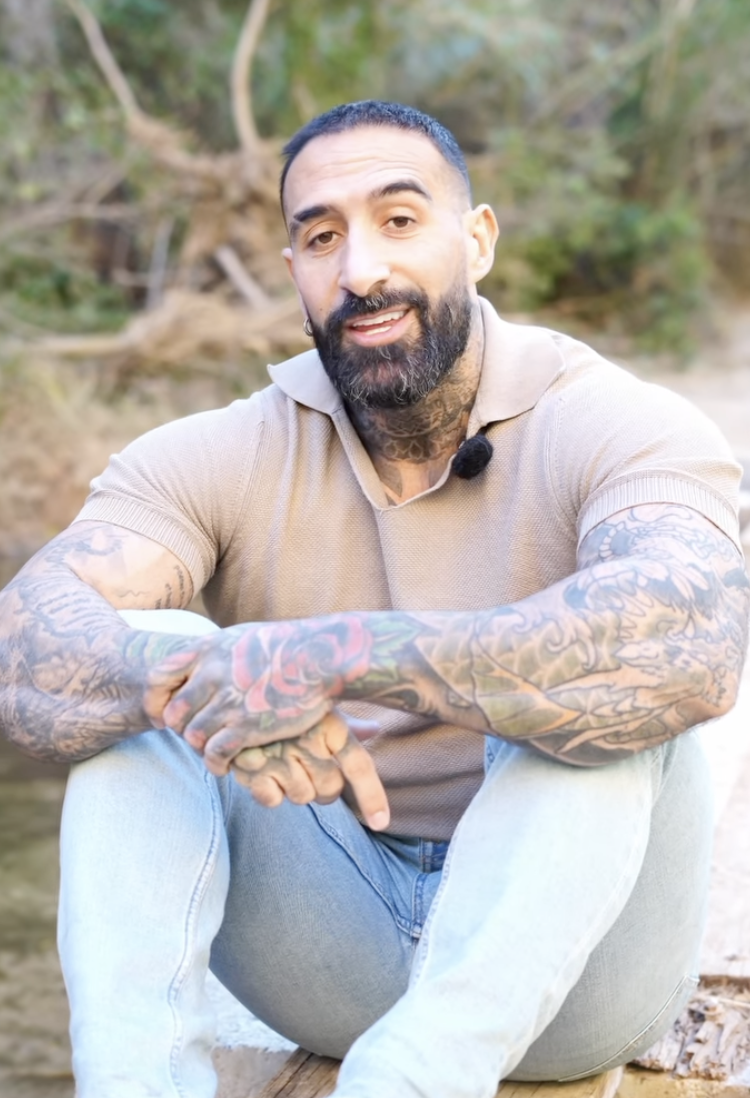
In contact with nature.
None of this is revolutionary. But it is what keeps the water in my glass more transparent than murky. And, on most days, that is perfectly enough.
In practice
You do not need to buy anything, or know any theory. You need seven minutes and to sit down.
Seven minutes of silence, every day. Forget the story about "empty the mind", that is nonsense. Sit down to notice its nature: you will see that the head does not shut up, that it jumps from thought to thought on its own. Great. That noticing is already half the work.
When you lose yourself in a thought, come back to the breath. And you will lose yourself. Dozens of times. Losing yourself is the exercise. You noticed you were buried in a thought? Return to the air going in and out. Again. And again.
Accompany the breath with a sentence in two parts. Breathing in, say mentally "I am not my body". Breathing out, "I am not my mind". Not like someone repeating a magic formula, but like someone slowly remembering that they can observe the body and the mind precisely because they are not only that. You are the observer of the glass, not the mud.
Posture helps. Seated, spine straight, in a meditation position. Palms facing up, resting on the thighs or knees. Head tilted slightly back. No mysticism: it is giving the body a stable shape for the mind to follow.
Bonus: a walk in nature, without your phone. Leave the device at home, or at least in your pocket and on silent. Walk, look, listen. You will find it strange for the first few minutes. Then you will understand what you had been running from.
Start today. Seven minutes. If you cannot find seven minutes to be with yourself, that is already, in itself, the answer to a question you may have been avoiding.
Do
Watch the mouth of someone you love while they speak.
Hug a friend.
Wake up in the night and go for a walk just because.
Sleep on the beach or in the forest.
Travel without a destination.
Give a coat to someone who needs it.
Try Vatapá (a Brazilian dish).
Read a good book.
Be kind.
Use your charm just to improve someone's day.
Do not greet with the cheek but with the lips.
Have a firm handshake.
Meditate at sunset. If you do not know how to meditate, sit down and be quiet for a good few minutes, and listen.
Plan, but be flexible.
Analyse, but do not judge (it is hard, I know).
Watch the sunrise.
Do not oversleep.
Do not watch too much television.
Lift your head.
Look at yourself in the mirror in the morning and talk with yourself.
Do not consider yourself the owner of anyone.
Give without wanting to receive.
Care without charging. But put yourself first.
Have dinner with yourself and enjoy the company.
A conclusion that isn't one
There is a whole explanation for why we are the way we are today.
The genetics imposed on us. The way we were treated. The events life kept serving us.
Our own reactions to those events, some conscious, most not.
All of it left marks on the way we perceive the world and react to it.
It shaped the filters through which we interpret everything that happens to us.
My research interest is understanding how we can, if we can at all, push back against that baggage.
Raising the degree of awareness so that the brain works for us and not against us. So that we have a say in the experiences we want to live.
In other words: seeing reality as it is, without falling for the illusions of our limited perception.
We are beings with the capacity to create characters. To put on masks as each situation demands. And that can be a conscious or an unconscious process. When it is conscious, we know when to put them on and when to take them off.
When we cling to them too tightly, we suffer.
My experience gives me proof of that. Observing other people does too.
I told you this about my mother and I am saying it again here, because it is the only thing I have learned that works for everything: pain is inevitable, and the suffering built on top of it is almost always optional.
A healthy body and a healthy mind are minimum requirements for a life well lived, but perhaps they are not enough for a full life. The third element is awareness.
The external experience does not depend only on us. But a well-kept mind and body, at the service of a developed awareness, raise the odds of the external conditions being favourable. And, above all, they allow whatever happens out there to be lived with some clarity and intention.
A step back from the mental content, from the stories we tell about ourselves and about the world, lets us see what is compulsion and what is choice. It lets us act from a conscious will, instead of reacting from fear or habit.
That demands vigilance. An active care.
Eating well. Sleeping well. Exercising the body. Meditating.
When we were small, they made us brush our teeth. It was tedious and we did not quite understand why.
Today we do it automatically. And that is why we have teeth. In 1866, most fifty-year-olds did not.
Taking care of ourselves is, therefore, a possibility, a privilege and, at the same time, a duty, if we want any say in our own life.
It is only a hypothesis. Thrown out with some degree of confidence.
Another hypothesis, for those for whom inner peace is a minimum requirement of a full life:
could an awareness progressively stripped of our stories, beliefs and ego be the answer?
Is it really so far-fetched to think that evolution produced a brain capable of observing its own impulses and reprogramming behaviours, and that this allows us to access progressively higher levels of awareness?
And what if that awareness, or rather, its development, is what allows the survival of the fittest in the future? How far can that logic take us?
Is there a creator? Will there be a moment when the creation and the creator meet?
Let me close with the idea that brought me here. We went back, at the very beginning, to a rudimentary cell, without a nervous system, without a brain, without the slightest idea of itself. From that cell to you, capable of reading these lines and doubting them, millions of years and millions of adaptations have passed. Each one, a small step. None of them planned by the one who took it.
And the question that stays with me is this: what if the next step is not physical? What if it is not one more limb, one more head, more strength, but the development of what I call, for lack of a better word, awareness? That "something more" that gives this last part of the book its name. Just as the cell had no way of imagining what it would become, we too have no way of imagining what we may become. And maybe it is not so far-fetched to think that, at some point, the creature and the creator meet. Or, more than that, realise they were always the same thing.
Let me confess something. This theory I formulated myself, in my own way. I shared it with a few people and, to be honest, they did not seem all that convinced. It left a flea behind my ear, and I started wondering whether anyone, anywhere, had ever thought the same. And it seems so. And a long time ago.
A yogi of the last century, Sri Aurobindo, wrote just this: that the human being is a transitional being, not the end of the line, and that the next rung of evolution belongs to consciousness, not the body. And long before him, some two thousand six hundred years ago, a sage called Uddalaka explained to his own son, in one of yoga's oldest texts, three words that still give me chills: Tat Tvam Asi. You are That. The idea that what you call "I" and what you call creator were never two. A drop that forgot, for a while, that it was the ocean.
So we are left with two hypotheses. Either we are all a bit mad, and every now and then someone shows up infected with the same madness. Or there is something here that deserves our attention. Or, at the very least, our questioning.
Trying to understand life through these perspectives may lead nowhere.
Or it may lead to everything.
They are questions that no longer trouble me, but they are always present, and they stop me from accepting anyone's certainties, including my own.
And perhaps it is worth leaving you, right at the end, the three lenses through which I have been looking at all of this.
Science, when it looks at free will, tends to say it is small. That we are far more driven by impulses, habits and conditioning than we like to admit.
The science of yoga goes further and points to a very different limit: the highest point would be total liberation from karma, that is, from all the accumulated memory that makes us react on autopilot. An almost unimaginable freedom.
And then there is me, somewhere between the two. In a limbo. I firmly believe it is possible to raise the degree of awareness and, with it, the margin of free will. What I do not know, and it would be dishonest to pretend I do, is how far it is possible to go.
Maybe a little. Maybe a lot. Probably more than science measures today. Where the ceiling is, I have no idea, and I would rather not pretend I do.
There are stories of yogis who claim to have left the body consciously, and of others who keep a portion of karma on purpose, just to remain able to act in the world. I do not know what is true there or how far the possible reaches. But I know there is room to grow. And that, for me, is already enough to make it well worth trying.
Take that with you.
From the archive · Truth (2023)
What is truth?
Sometimes I catch myself holding debates in my head on a given topic, taking both positions, knocking down every argument each position holds as truth. It is frustrating to realise that whatever truth we believe to be real is so easily knocked down.
Sometimes we take a position on a given subject without truly questioning its validity.
Sometimes I do find one or another statement that is solid enough, that makes sense and is truly felt. Not because it was read somewhere, but because it was lived. It is still, however, a statement with a very subjective view, made from our position (privileged, some say; less privileged, say others).
But since I have the possibility of working with a great many people, I can test the solidity of those statements with them. Observing each one, their pains, their moments of happiness, their moments of doubt, the moments when they are lost.
Descriptions, definitions and words are at once necessary and dangerous. We need our inner speech to be coherent and precise. To know where we are and where we want to go, we need that rigour.
To communicate with others too.
Although we communicate with much more than words, they matter, and so does the care in choosing them. They are dangerous, however, when we try to generalise complex ideas or when we use them with ill intent.
I share with you things that at this moment are solid truths for me:
• Before wanting to fix the world and our neighbour, we should fix ourselves. We are good and evil at the same time, in constant struggle. We are dual.
And sometimes what we criticise says more about us than about the other person.
• Taking responsibility for our conduct, for the pursuit of progress (and its achievement) and for a raising of awareness. Starting from that constant personal improvement, without words, leading by example, we can influence others.
• There is no order without chaos. We want a little of both. Let us not seek the easiest path, let us seek the path that will make us better.
I live, and watch others live, all of these points, in one way or another. I notice patterns and try to use them to understand myself and to understand the world.
Epilogue
From the archive · Here I Sit, Guarda, Highest City in Portugal (2020)
Here I sit today, where I once prepared myself for life, for the world and for leaving for secondary school. Breakfast was well traditional:
a small slice of buttery cheese, a bread roll, malted chocolate drink with sugar and a dose of hope for the day I could leave this place.
I wanted out. I was mentally prepared to throw myself to the wolves with the mission of leading the pack. I was a strange kid. I still am.
I felt caged in a little village. I felt they were showing me a juicy steak on the other side, and I stood there drooling, trying to break through the cage to grab it. Such was my desire to leave.
Here I sit today, more mature (at least I hope), knowing there are plenty of other steaks that make my mouth water and that I want to reach.
I appreciate what once looked to me like a cage.
Today I feel it and smell it as home. The silence I used to hate, the lack of bustle, is at this precise moment a synchronised, relaxing melody.
The change of perspective comes with the passing of time and experiences.
I know today that the freedom I fought so hard for is mine to enjoy. Being where I want, with whom I want, doing what I want, and feeling that freedom of choice is without doubt one of my most pleasurable achievements.
Here I sit today, able to appreciate and to dream.
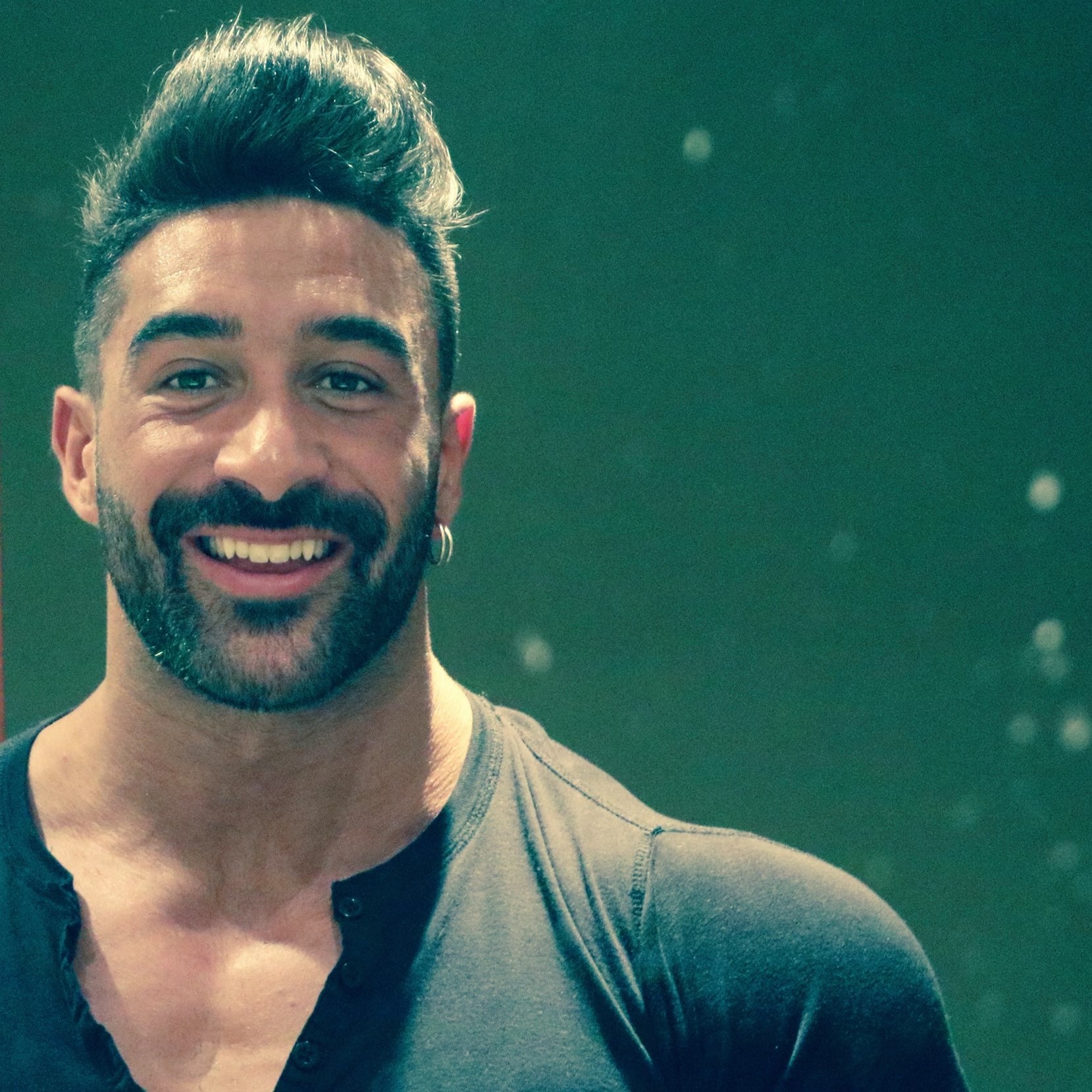
Tiago Gonçalves (Tiago T3).
The end · back · download the PDF ↓